Why Most Leadership Training Fails — and the Four-Stage Fix
Most leadership training fails before and after the session, not during it. Here's why, and a four-stage sequence that makes new behavior stick.
Most organizations have bought leadership training at least once. A cohort of managers spends two days in a hotel ballroom or a video call, fills a binder with models, rates the session a 4.6 out of 5 — and six weeks later, nothing on the floor looks different. The same meetings run long. The same conflicts get avoided. The same high performer quits.
When that happens, it's tempting to blame the vendor, the content or the managers. Usually none of them is the real problem. Leadership training tends to fail for structural reasons: it skips steps that have to come first, and it stops before the step that makes it stick. This post walks through why that happens and lays out a four-stage sequence you can use to make your next investment in leadership training actually work.
The gap is real, and it's growing
Before looking at why programs fail, it's worth being clear about what's at stake. Managers are the people most leadership training is aimed at, and they are struggling. Gallup's State of the Global Workplace report found that manager engagement fell from 30% to 27% in 2024. That matters because managers shape the day-to-day experience of everyone who reports to them.
Skill gaps show up too. In LifeLabs Learning's 2026 mid-year trends research, drawing on more than 20,000 people, 56% rated their managers' coaching and feedback capability at 5 out of 10 or lower. Only 14% rated it 8 to 10.
Those numbers don't mean organizations aren't training managers. Many are. They suggest that a lot of the training isn't turning into changed behavior.
Five reasons leadership training fails
In practice, failed programs tend to share a handful of patterns. See how many you recognize:
- It starts with a curriculum instead of a diagnosis. A generic course on "communication" or "accountability" gets rolled out to everyone, whether or not that's where the team is actually losing ground.
- It treats leadership as information. Managers learn a model, can describe it accurately, and still don't use it when a real conversation gets tense.
- There's no practice under realistic pressure. People rehearse once in a low-stakes role play, then face the real thing alone.
- It's an event, not a system. The program ends on Friday. Nobody follows up, and the manager's boss never asks what changed.
- No one agreed on what success looks like. Without indicators set up front, the only evidence available is a satisfaction survey.
Notice that most of these failures happen before or after the training itself. The content in the room is rarely the weakest link.

The four-stage fix
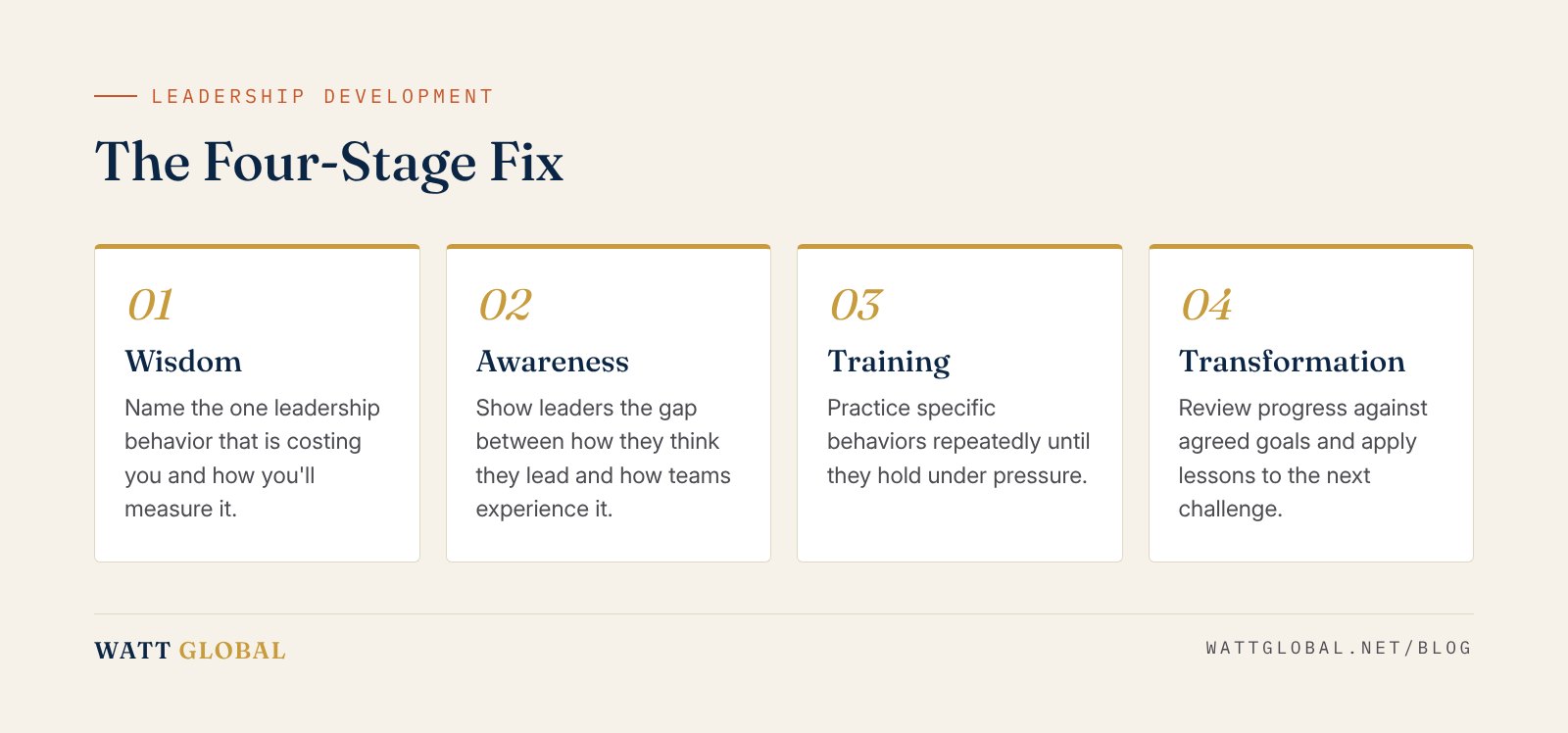
The WATT Framework™ grew out of years of watching what helps people change and what doesn't. It arranges leadership development into four stages, taken in order: Wisdom, Awareness, Training and Transformation. Each one builds the conditions for the next. Skip one, and the stages after it have nothing to stand on.
Stage 1: Wisdom — get clear before you get busy
Wisdom is about clarity: what you're trying to achieve, which priorities matter, and which decisions actually need your attention. For an organization, that means naming the specific leadership behavior that's costing you. Is it managers who avoid hard conversations? Supervisors who can't delegate? Leaders who make decisions but never explain them?
A useful test: if you can't describe the change you want in a sentence a frontline employee would recognize, you aren't ready to buy training yet.
Stage 2: Awareness — see the pattern you're part of
Awareness means recognizing patterns, listening well and understanding the impact you have on others. This is where leaders discover the gap between how they think they lead and how their team experiences them. It's uncomfortable, and it's also where real motivation to change comes from. Feedback, observation and honest reflection belong here — before any new skill is taught.
Stage 3: Training — practice until it holds under pressure
Only now does skill-building make sense. Training in this sense means practicing specific behaviors and building habits, not absorbing content. Short, focused sessions with repeated practice beat long sessions with one role play. The goal is a behavior a manager can produce on a bad day, with an upset employee in front of them.
Stage 4: Transformation — review, apply, repeat
Transformation is where you review progress against the goals you agreed on in stage one and apply what you've learned to the next real challenge. This is the stage most programs leave out entirely. It's also the one that turns a training event into a lasting change in how your organization operates.
Insight that isn't practiced becomes a memory. Practice that isn't reviewed becomes a habit you never chose.
What this looks like in a real program
Picture a regional operations director with 40 shift supervisors. Exit interviews keep mentioning "my supervisor never told me how I was doing." A typical response would be to book a feedback workshop for all 40 and call it done.
A four-stage approach looks different:
- Wisdom: The director and HR agree on one outcome — supervisors hold a short, specific feedback conversation with every direct report at least twice a month — and pick two indicators they already track, such as early turnover and pulse-survey items on feedback.
- Awareness: Supervisors gather quick input from their teams and compare it with their own self-ratings. Most discover they give far less feedback than they believe.
- Training: Supervisors attend short, practice-heavy sessions and rehearse real scenarios from their own shifts, not generic case studies.
- Transformation: Each month, supervisors and their managers review the agreed indicators, talk through what's working and adjust.
The content of the training might be similar to the generic workshop. The difference is everything around it.
How to fix your next program
You don't need to throw out what you already have. Before your next leadership training investment, run through these questions:
- Have we named the specific behavior we want to change, in plain language?
- Have we agreed on two or three indicators we'll review afterward?
- Do participants get honest input on how they currently lead before the training starts?
- Does the program include repeated practice, not just one role play?
- Is there a scheduled review 30, 60 and 90 days after the sessions end?
- Do participants' own managers know what was taught and how to reinforce it?
If you answer "no" to more than two, the content probably isn't your biggest risk. The structure is.
Build training that holds
Leadership training fails when it's treated as a single event that delivers information. It works when it's a sequence: clarity first, then honest awareness, then deliberate practice, then a structured review that keeps the change alive. That's not a radical idea, but it is a disciplined one, and discipline is what most programs are missing.
At WATT Global, every coaching engagement and team workshop runs through that same order, because the order is what makes the work last. If you want to see how each stage works in more detail, explore the WATT Framework and decide where your own leadership pipeline needs attention first.