Executive Coaching vs. Leadership Training: Which Does Your Organization Need?
Coaching goes deep with one leader; training builds shared skills across many. Here's how to tell which your organization needs, and when to use both.
When a leadership problem lands on your desk, two options usually come up first: hire an executive coach, or run a leadership training program. Both are legitimate. Both can work. But they solve different problems, and choosing the wrong one is one of the most common ways organizations waste a development budget.
This guide breaks down what each option actually does, when each one fits, and how to decide between them — or combine them — based on the problem in front of you rather than on habit or vendor pitches.
What executive coaching actually is
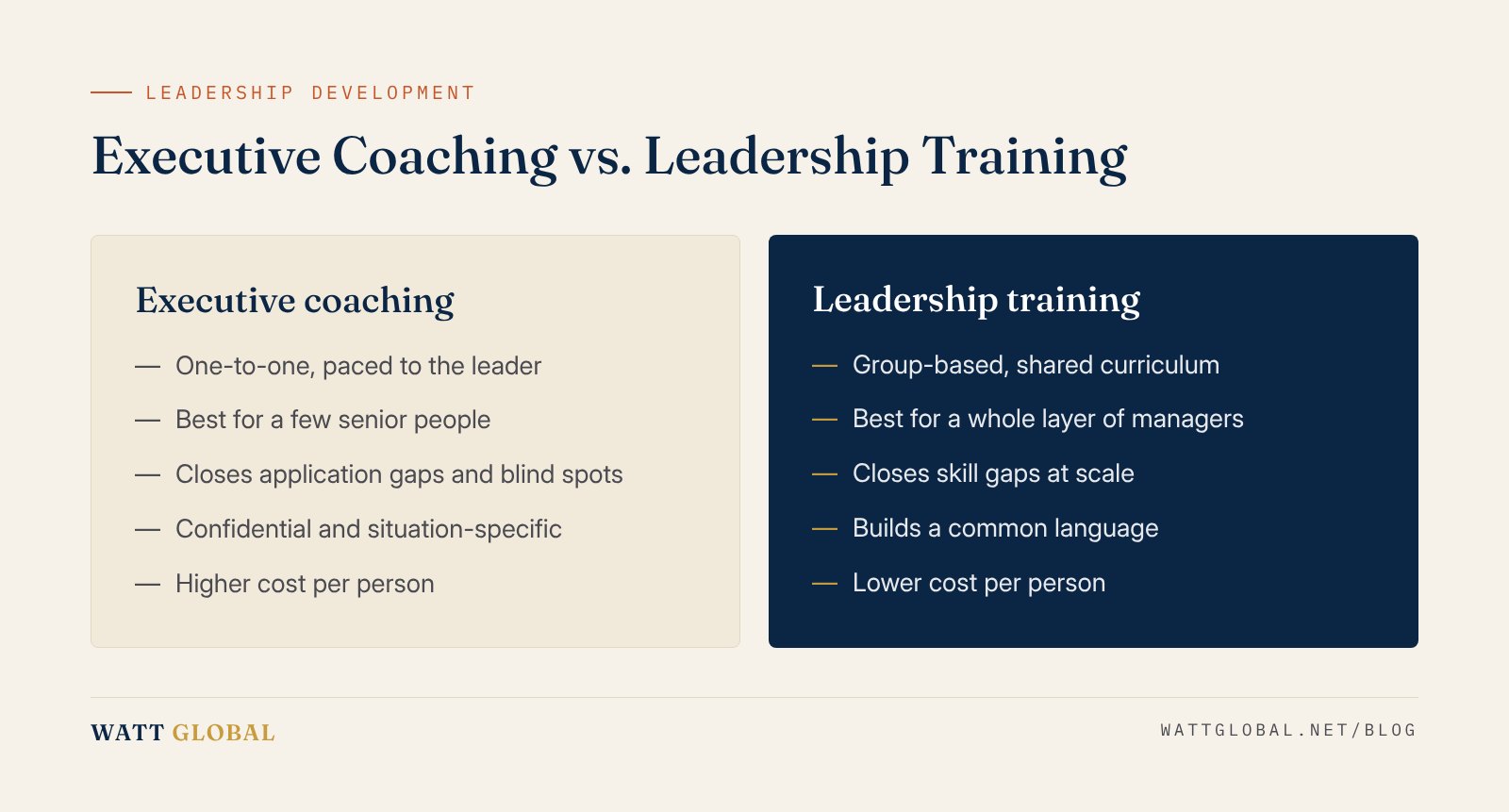
Executive coaching is one-to-one work between a leader and a coach over a period of months. It's built around the individual: their role, their decisions, their blind spots and the pressures they face this quarter. There's no fixed syllabus. A good coach helps a leader see their own patterns more clearly, test new approaches in real situations and reflect on what happened.
Coaching tends to be most valuable when:
- The stakes sit with one person. A founder whose company has outgrown how they lead, a new executive in a high-visibility role, or a successor being prepared for a bigger job.
- The problem is personal and specific. How someone handles conflict with a peer, makes decisions under pressure or shows up in the boardroom.
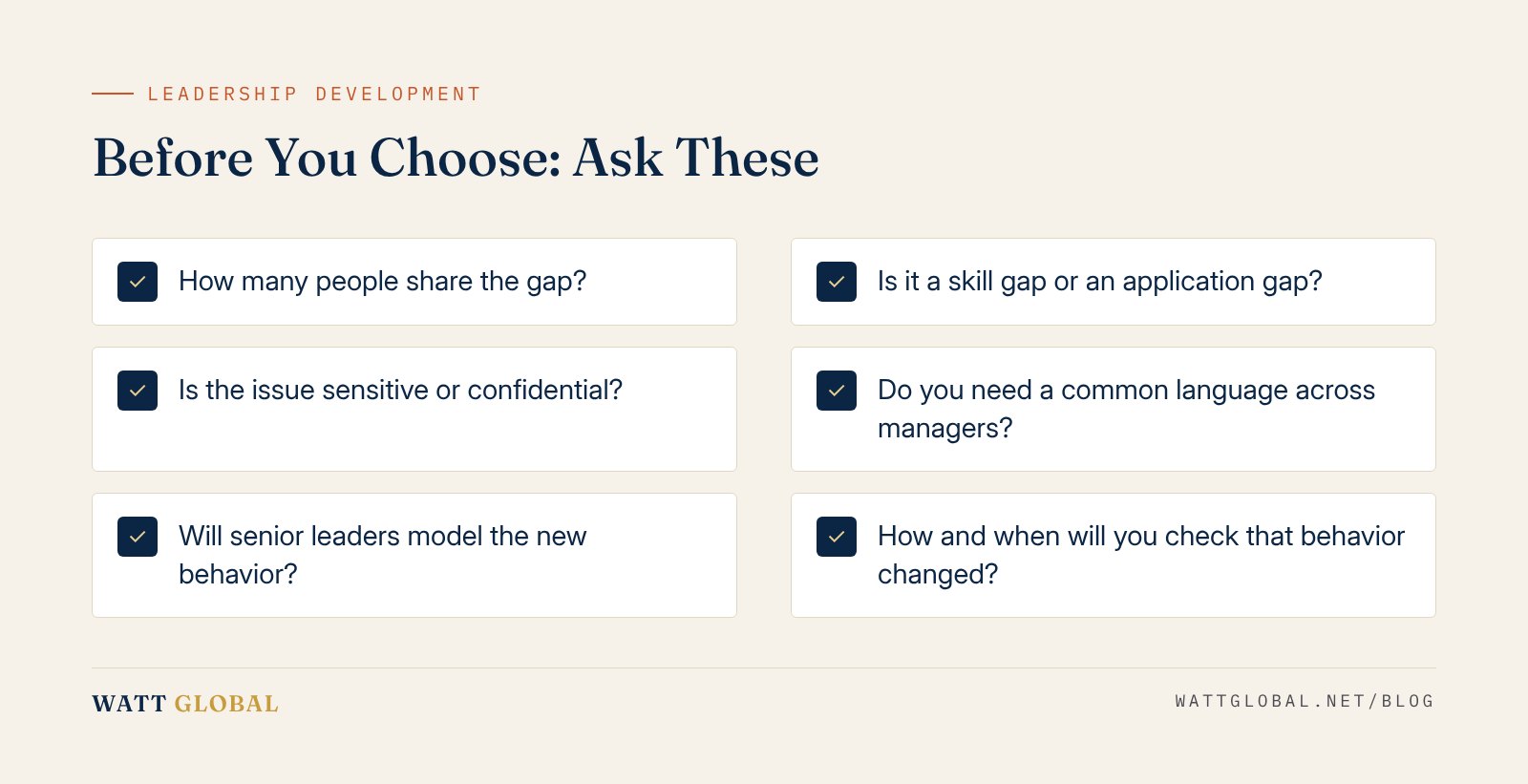
- Confidentiality matters. Senior leaders often can't work through certain issues in front of colleagues.
The trade-off is reach. Coaching changes one leader at a time, and it costs more per person than group development.
What leadership training actually is
Leadership training is group-based development built around shared skills: giving feedback, running one-on-ones, handling difficult conversations, delegating, leading through change. It can be a workshop series, a cohort program or short modules delivered over several weeks.
Training tends to be most valuable when:
- Many people need the same skill. For example, a group of newly promoted supervisors who have never had to give corrective feedback.
- You want a common language. When managers share a model for conversations or decisions, they can hold each other to it.
- The gap is capability, not context. People don't know how to do something yet, rather than knowing how and struggling to apply it in a tricky situation.
The trade-off is depth. A group program can't tailor itself to every person's situation, so individuals with complex challenges may need more.
The real question: who has the gap, and what kind?
Instead of asking "coaching or training?", ask two simpler questions.
How many people share the gap?
If the problem sits with one or two senior people, coaching is usually the better fit. If it shows up across a whole layer of management, training is usually more efficient — and coaching each of those people individually would be expensive and slow.
The frontline layer is a common example. Harvard Business Publishing research found that only 12% of executives said their organization invests enough in frontline manager development. Gaps at that level are rarely one person's problem; they're shared across dozens or hundreds of supervisors, which points toward a well-designed training program.
Is it a skill gap or an application gap?
A skill gap means people don't yet know how to do something. An application gap means they know how, but something gets in the way: pressure, habit, politics, fear or a blind spot they can't see.
Training is strong at closing skill gaps. Coaching is strong at closing application gaps, because it works on the specific situation and the specific person.
The LifeLabs Learning 2026 mid-year trends research, drawing on more than 20,000 people, found that 56% rated manager coaching and feedback capability at 5 out of 10 or lower. A gap that wide across a workforce is usually a skill gap first — something a structured program can address at scale.
Coaching changes how one leader shows up. Training changes what a whole team treats as normal. Know which problem you're solving before you choose.
A quick decision guide
Use this as a starting point when you're weighing the two:
- Choose executive coaching if the gap belongs to a small number of senior leaders, the issues are sensitive, and the challenge is tied to specific decisions or relationships.
- Choose leadership training if many managers share the gap, you want a common language and standard, and people need to learn a skill they don't yet have.
- Combine them if a team needs a shared skill but a few leaders also face complex personal challenges, or if senior leaders need to model the behavior the rest of the organization is learning.
Budget matters too, but it shouldn't be the first filter. A training program that reaches 40 managers can look cheaper per person than coaching for one executive, yet if the real problem is how that one executive runs the leadership team, the 40-person program won't touch it. Likewise, coaching every new supervisor individually is rarely the best use of money when most of them need the same basic skills. Match the format to the problem first, then size it to the budget you have.
Why the best programs often use both
Coaching and training aren't competitors. Some of the strongest development efforts pair them deliberately. Picture a leadership team rolling out a new approach to performance conversations. Every manager attends a short, practice-heavy training series. Meanwhile, the three senior leaders work with a coach to make sure they model the same behavior — because if executives don't change, managers quickly learn the training was optional.
Another common pattern: run group training first, then offer a limited number of coaching sessions to managers who are struggling to apply it. That targets your coaching budget at the people and situations that most need it.
Whichever mix you choose, the same principle applies: start with a clear picture of the problem, build awareness before skills, practice deliberately and review progress against goals you agreed up front. That's the sequence behind the WATT Framework, and it applies equally to one leader and to a hundred.
Questions to ask any provider
Whether you're hiring a coach or a training partner, ask:
- How do you diagnose the problem before recommending an approach?
- How will we know whether behavior has changed, and when will we check?
- How do you involve participants' own managers?
- What happens after the sessions end?
- Can you describe how you'd handle a leader who isn't engaging?
Vague answers to these questions are a warning sign, whatever the format.
Choose the format that fits the problem
Executive coaching and leadership training are different tools. Coaching goes deep with one person; training builds shared capability across many. The right choice depends on who has the gap and whether it's a gap in skill or in application — and often the answer is a deliberate combination of both.
WATT Global offers executive and leadership coaching alongside team workshops and workforce training, so the recommendation can follow the problem rather than the product. To see how each option works and who it's built for, compare our leadership solutions and see which one matches what your organization needs right now.