Writing a Training Statement of Work That Gets Better Proposals
A section-by-section guide to writing a training statement of work that vendors can price accurately, with a template outline you can adapt.

The quality of the proposals you receive is capped by the quality of the statement of work you send out. A vague SOW gets vague proposals: generic curricula, padded prices and assumptions you will spend weeks untangling after award. A clear one gets responses you can actually compare.
This guide walks through how to write a training statement of work that gets better proposals, section by section, with a template outline you can adapt. It is written for federal, state and local program staff, and for corporate buyers who run formal sourcing. It is general guidance, not legal or contracting advice. Your contracting office decides the format and required clauses, so check the current FAR or your agency's procurement rules before you finalize anything.
Why the SOW matters more than the evaluation criteria
Evaluation criteria tell vendors how you will score them. The SOW tells them what they are actually pricing. When the work is unclear, careful vendors price in risk, and less careful ones underbid and come back later with change requests. Either way, you lose.
A strong training SOW does three things:
- Describes the problem clearly enough that vendors can propose a real solution.
- Defines the scope tightly enough that prices are comparable.
- States how success will be judged so everyone knows what "done" means.
If two qualified vendors would read your SOW and picture different projects, it isn't finished yet.
SOW, PWS or SOO: choosing the right shape
Federal buyers will meet three related document types. Your contracting officer will advise on which fits, and the FAR's guidance on performance-based acquisition is the place to start.
- Statement of Work (SOW): describes the work to be done, often in some detail. Useful when you know exactly what you want delivered.
- Performance Work Statement (PWS): describes the required results in measurable terms and leaves more of the "how" to the vendor. Favored for performance-based acquisitions.
- Statement of Objectives (SOO): states the high-level objectives and asks vendors to propose their own approach, sometimes including their own PWS.
For most leadership and workforce training buys, a results-focused SOW or a PWS works well. The section guidance below applies to both.
The sections of a strong training SOW
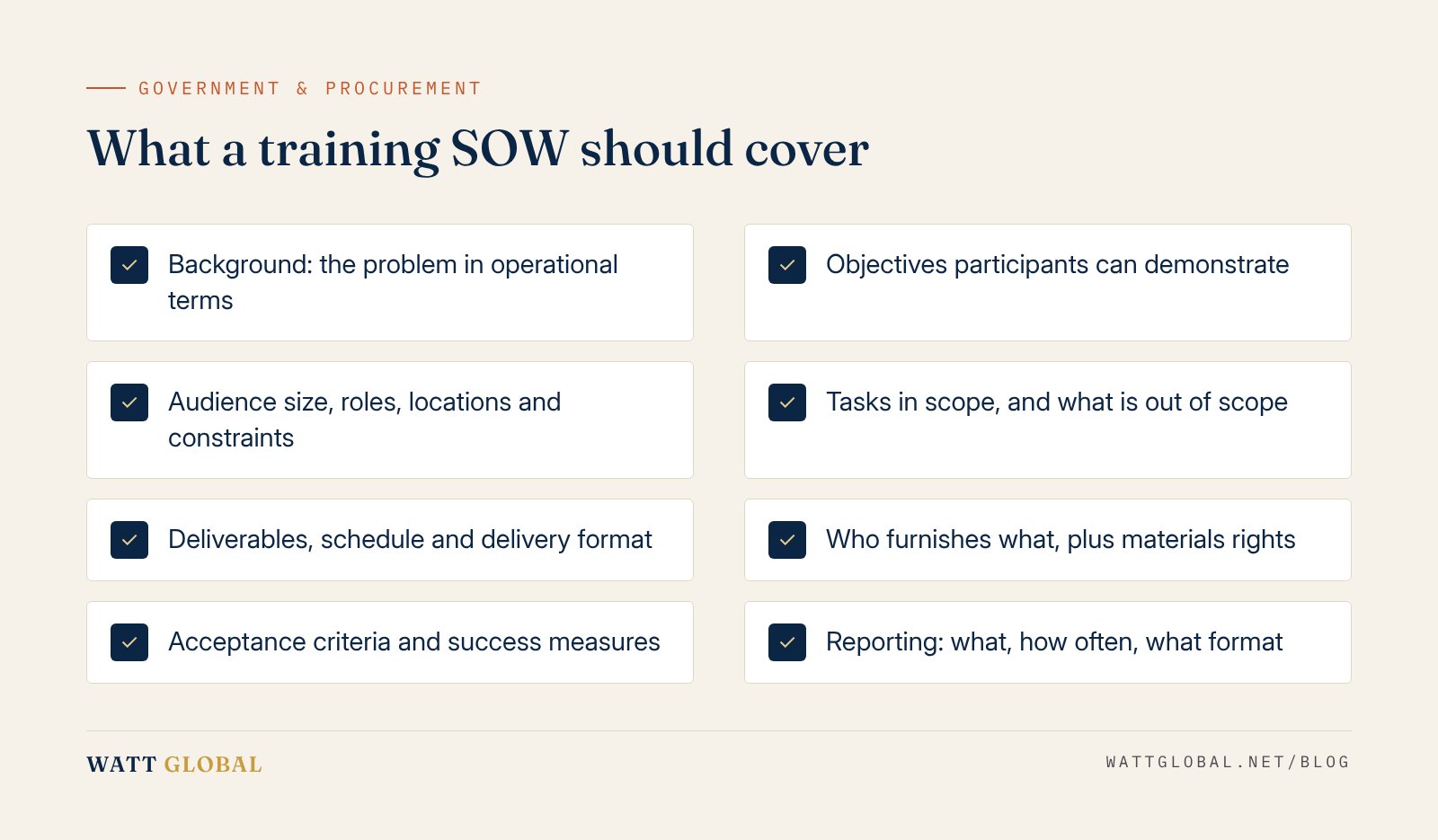
1. Background
Two or three paragraphs on your organization, the program and why this training is needed now. Describe the problem in operational terms: "New supervisors are promoted from frontline roles with no formal preparation" gives a vendor far more to work with than "leadership skills need improvement."
2. Objectives
State what participants should be able to do after the training, and what should change in the workplace as a result. Keep objectives observable. "Conduct a structured feedback conversation" can be assessed; "understand feedback" cannot.
3. Audience
This is where many SOWs fall short. Include:
- Number of participants, and whether that number is firm or an estimate.
- Roles and experience levels.
- Locations, shifts and any scheduling constraints.
- Any accessibility or language needs you already know about.
4. Scope of work and tasks
List the tasks you expect, such as a needs assessment, curriculum design or customization, delivery, facilitator guides, train-the-trainer sessions and reporting. Be clear about what is out of scope, too. If the vendor shouldn't handle venue or travel logistics, say so.
5. Deliverables and schedule
For each deliverable, name the format, the due date or milestone and who reviews it. A short table works well here. Include the period of performance and any blackout dates, such as peak operating seasons.
6. Delivery format
In person, virtual live, self-paced or blended? Session length and number of sessions? If you prefer short modules that fit around shift work, say so. If any digital materials or e-learning are included, federal buyers should reference Section 508 accessibility requirements.
7. Government-furnished items and responsibilities
What will you provide? Rooms, equipment, subject-matter experts, policy documents, participant lists? What do you expect the vendor to supply? Unclear responsibilities are a common source of disputes after award.
8. Materials and data rights
State whether you need the right to reuse, modify or redistribute training materials after the contract ends, for example to run internal refreshers. This affects price, so it belongs in the SOW, not in a post-award conversation. Your contracting office will advise on the applicable clauses.
9. Acceptance and success measures
Explain how deliverables will be accepted and how the program's results will be reviewed. Use indicators you already track where possible: completion, participant assessments, supervisor observations or operational measures. Agree on when they will be checked.
10. Reporting
Specify what reports you need, how often and in what format, such as attendance, completion, evaluation summaries and recommendations.
Common mistakes that weaken proposals
These show up again and again in training solicitations:
- Naming a topic instead of a problem. "Leadership training" invites a catalog. A stated problem invites a solution.
- Leaving headcount open. Without even a range, vendors can't price consistently.
- Over-prescribing the method. Specifying every slide and exercise prevents vendors from proposing something better. Describe the result and let them show their approach.
- No measure of success. If you don't say how results will be judged, every vendor will promise "engagement."
- Forgetting what happens afterward. If you want to sustain the training internally, ask for train-the-trainer delivery and reusable materials up front.
Vague versus specific: a quick example
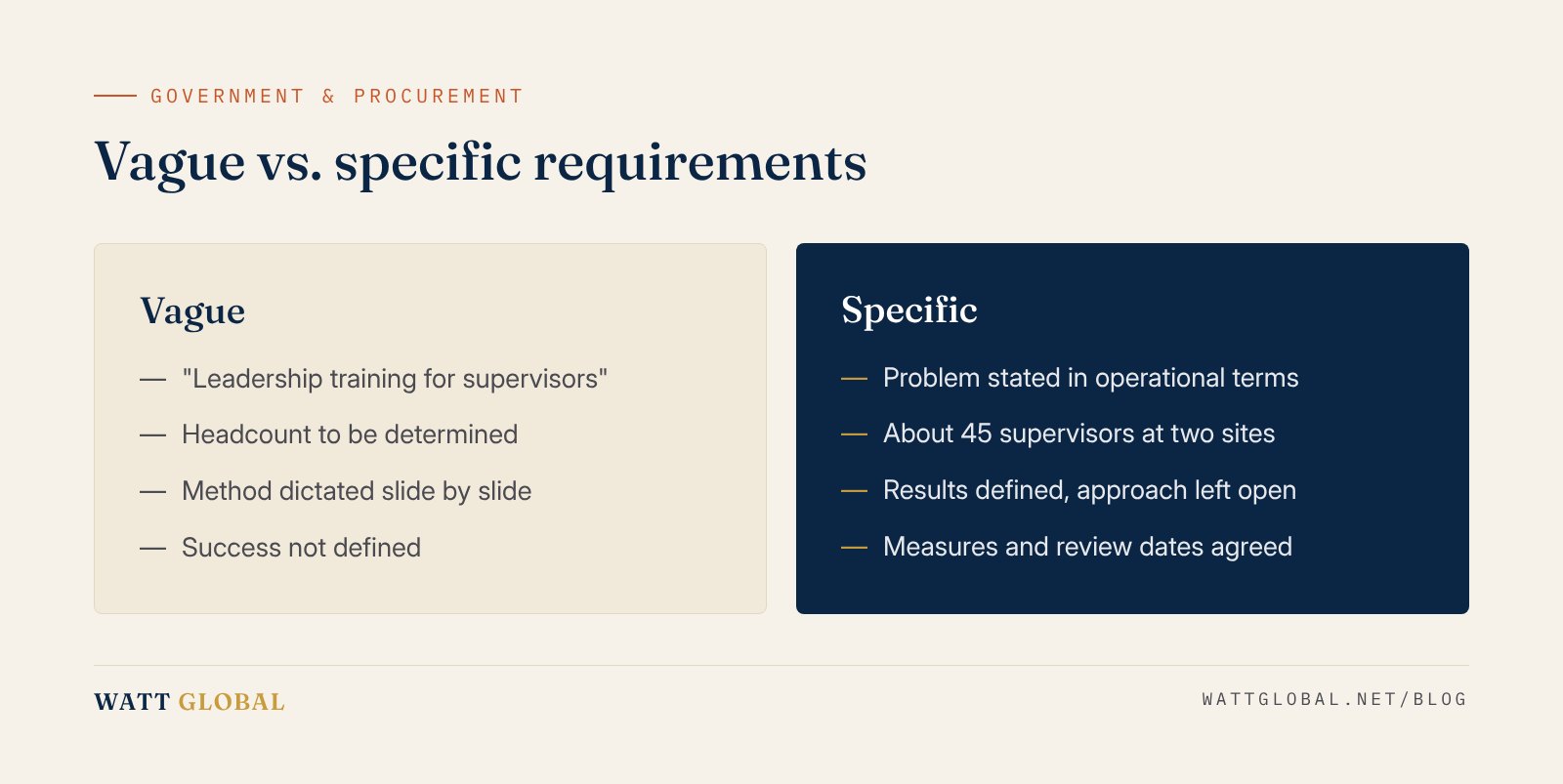
Picture a hypothetical agency requirement. The vague version: "Provide leadership training for supervisors." The specific version: "Deliver a supervisor development series for approximately 45 first-line supervisors across two sites, in six 90-minute sessions over three months, focused on feedback, conflict and coaching conversations, with a facilitator guide the agency may reuse internally and a final report on participant assessments."
The second version takes ten more minutes to write and saves weeks of clarification questions. It also makes proposals far easier to evaluate side by side.
A template outline you can adapt
Use this skeleton as a starting point and adjust it to your agency's format:
- Background
- Objectives
- Audience (size, roles, locations, constraints)
- Scope of work and tasks (including what is out of scope)
- Deliverables and schedule
- Delivery format and accessibility
- Government-furnished items and vendor responsibilities
- Materials and data rights
- Acceptance criteria and success measures
- Reporting requirements
Write the SOW you would want to answer
A good training statement of work is specific about the problem, the audience and the definition of success, and open about the method. Write it the way you would want to receive it if you were the vendor, and the proposals you get back will be easier to compare and easier to manage after award.
WATT Global responds to training solicitations for leadership development, onboarding, de-escalation and instructional design, and our solutions page outlines what we deliver. If you have a draft SOW or an open solicitation, share it through our procurement page with the solicitation number and deadline, and we will follow up.