How Government Agencies Buy Leadership Training: A Plain-English Guide
Thresholds, contract vehicles and registration basics, explained for program managers who need leadership training and want the purchase to go smoothly.

If you manage a government program and need leadership training for your supervisors, you have probably discovered that wanting the training is the easy part. Buying it means navigating thresholds, contract vehicles, registration requirements and set-aside rules, often with a contracting officer whose queue is already full.
This guide explains, in plain English, how government agencies buy leadership training: the main paths, the dollar thresholds that decide which path applies, and what you can do as a program manager to make the purchase faster and the proposals better. It focuses on US federal buying, with notes on state and local differences. It is general information, not legal or contracting advice. Rules change, so always check the current FAR and your agency's own policies with your contracting office.
Who is involved in a training purchase
Three roles show up in almost every federal training buy:
- The program or requiring office. That's you: the people who need the training and know what success looks like. You define the requirement.
- The contracting officer (CO). The only person with authority to obligate the government. The CO chooses the acquisition approach, runs the competition and signs the award.
- The contracting officer's representative (COR) or purchase cardholder. Depending on the size of the buy, someone in or near the program office may monitor performance or make the purchase directly.
The single most useful thing a program manager can do is involve the contracting office early and arrive with a clear requirement. More on that below.
The dollar thresholds that shape everything
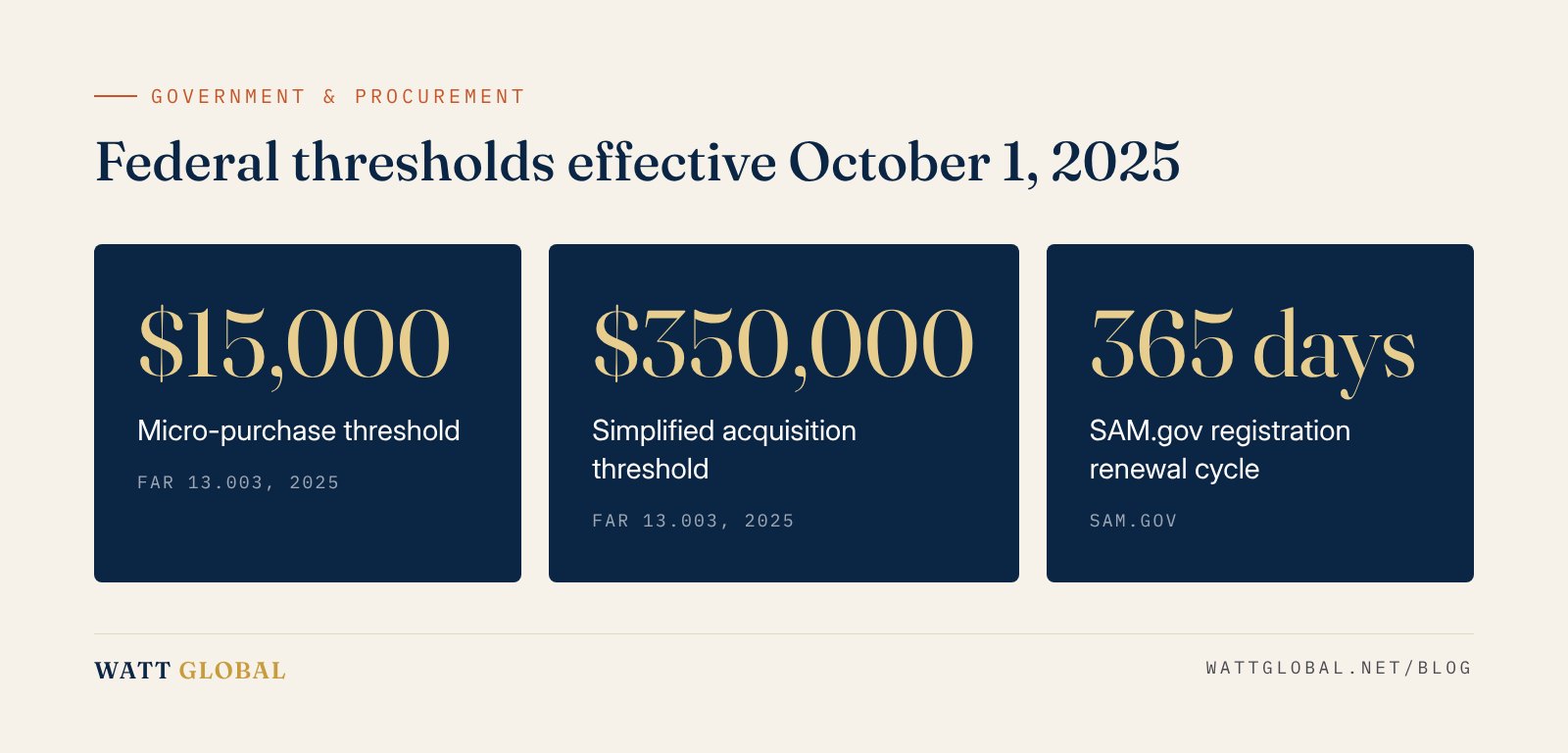
Federal purchasing rules scale with the estimated value of the buy. Under the thresholds effective October 1, 2025, the micro-purchase threshold is $15,000 and the simplified acquisition threshold is $350,000 (FAR 13.003; GSA SmartPay).
At or below the micro-purchase threshold
Small purchases, such as a single half-day workshop for one team, can often be made with a government purchase card by an authorized cardholder, with less formal competition. Agencies still expect the price to be reasonable, and many add their own internal approvals for training.
Between the micro-purchase and simplified acquisition thresholds
Most mid-size leadership programs land here: a cohort series, a supervisor academy for one region, a set of workshops across several sites. Simplified acquisition procedures apply, which usually means a request for quotes and a lighter evaluation than a full-scale competition.
FAR 13.003 also generally reserves purchases in this range for small businesses, with exceptions your contracting officer will know. For leadership training, this often means the competition is among small firms.
Above the simplified acquisition threshold
Larger, multi-year or enterprise-wide programs move into more formal procedures, with fuller evaluation criteria, longer timelines and more documentation. If your requirement is heading here, bring the contracting office in months ahead, not weeks.
The main buying paths
Within those thresholds, agencies have several ways to buy training. Your contracting officer chooses the vehicle, but knowing the options helps you ask the right questions.
- Government purchase card. Fastest path for small, well-defined buys within the cardholder's authority.
- Open-market simplified acquisition. The agency posts or sends a request for quotes, compares responses and awards.
- GSA Multiple Award Schedule (MAS). Pre-competed contracts where pricing and terms have already been negotiated. Professional and management development training falls under SIN 611430 (GSA). Agencies can order from schedule holders through GSA's ordering procedures.
- Existing agency vehicles. Blanket purchase agreements (BPAs) or indefinite-delivery contracts your agency already holds for training or professional services. Ask whether one exists before starting from scratch.
A clear requirement is the fastest contract vehicle there is.
What every vendor needs before award
Whatever the path, a few basics apply to the companies you buy from.
- SAM.gov registration. Registration in SAM.gov is required for federal awards, and it must be renewed every 365 days (SAM.gov). An expired registration can delay an award.
- A Unique Entity ID (UEI). The 12-character UEI replaced the DUNS number on April 4, 2022, and is how the government identifies an entity.
- NAICS codes that fit the work. Leadership and management training is commonly associated with codes such as 611430 (professional and management development training) and 541611 (management consulting). The solicitation's NAICS code determines the small business size standard that applies.
A vendor's capability statement should show all of this at a glance. You can confirm registration status yourself with a public entity search on SAM.gov.
State and local agencies work differently
State, county and city agencies follow their own procurement codes, not the FAR. Thresholds, quote requirements, approved vendor lists and cooperative purchasing agreements vary widely. Some states allow purchases from cooperative contracts held by other public entities; others require local competition for almost everything.
If you work in state or local government, the principles in this guide still help: know your estimated value, involve purchasing early and write a clear scope. But confirm the specific thresholds and procedures with your purchasing office.
How program managers can speed things up
You can't change the rules, but you can make the process run smoothly. Before you ask your contracting office to buy training:
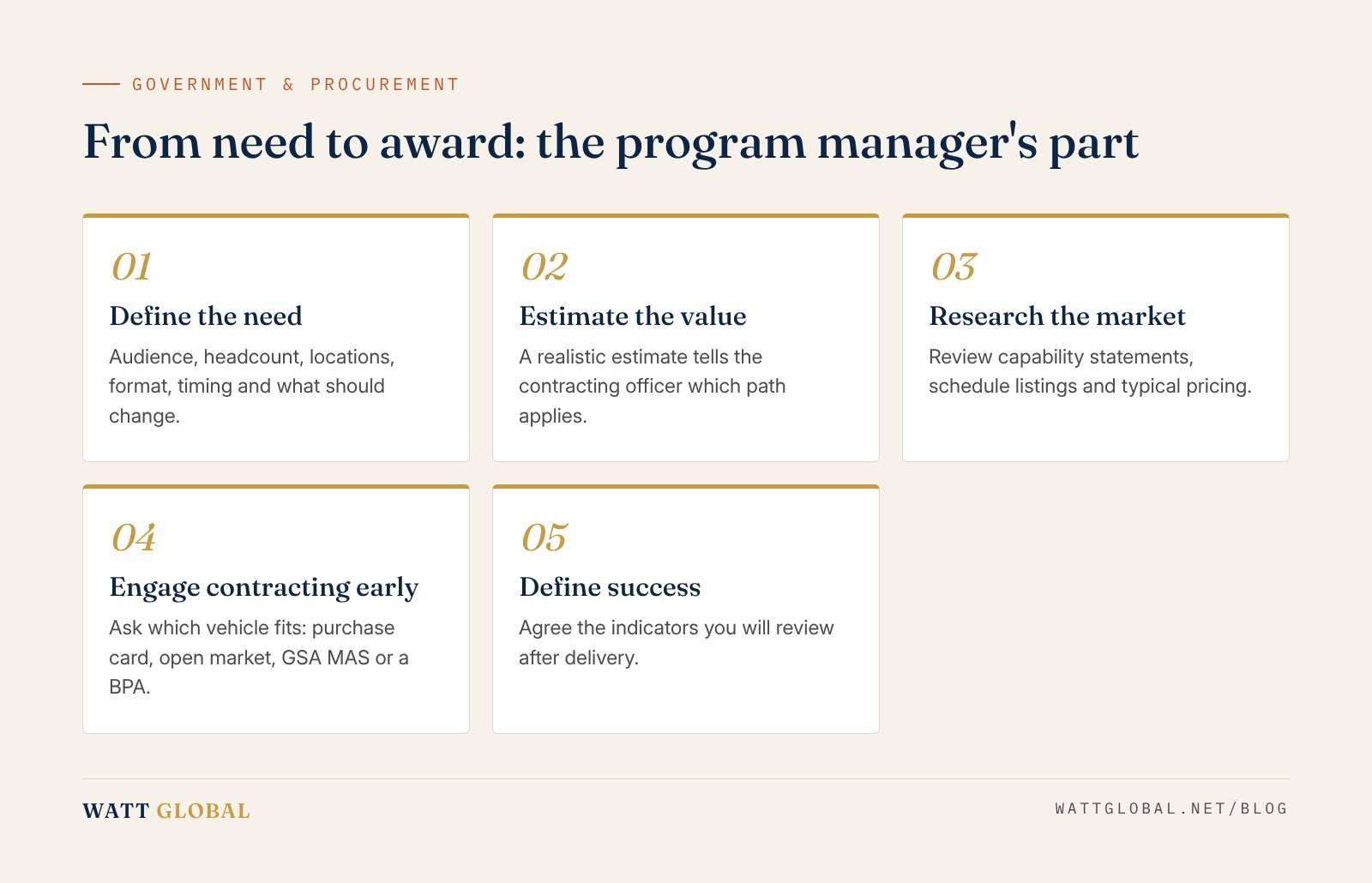
- Write a clear statement of need. Who is the audience, how many people, where, in what format, by when, and what should change afterward?
- Estimate the value realistically. A sensible independent estimate helps the CO choose the right path.
- Do light market research. Look at what similar programs cost and who offers them. Capability statements and schedule listings are a good start.
- Define success. Name the indicators you will review after delivery, such as supervisor confidence, employee survey items or operational measures you already track.
- Plan logistics. Venue, travel, materials and accessibility requirements all affect price and timeline.
Picture a hypothetical regional office that needs a supervisor development series for 60 new frontline supervisors across three sites. A program manager who arrives with headcount, locations, preferred format, a target window and three success measures gives the contracting officer a requirement they can act on the same week. One who arrives with "we need leadership training" starts a month of back-and-forth.
Turning your requirement into a proposal
Buying leadership training in government is less mysterious than it first appears. Know where your estimated value falls against current thresholds, ask your contracting officer which vehicle fits, confirm vendors are registered and write a requirement specific enough to compare proposals fairly.
WATT Global is registered in SAM.gov (UEI JX9JXMK5KLA9, CAGE 249C9, primary NAICS 541611, with 611430 among our additional codes) and works with agencies on leadership development, facilitation, onboarding and procurement coordination. Our solutions page explains the leadership offer in more detail. When you're ready, send your scope or solicitation through our procurement page and download our capability statement for your files.