Reading a Capability Statement: What UEI, CAGE and NAICS Codes Tell Buyers
What UEI, CAGE and NAICS codes on a capability statement do and don't tell you, and how to read the rest of the page with a buyer's eye.

A capability statement is usually one page, sometimes two. Contracting officers, program managers and prime contractors see dozens of them, and most get a quick scan before a decision is made about whether to read further. The codes near the top, UEI, CAGE and NAICS, are a big part of that scan.
If you buy services for a government agency, or you work for a prime contractor looking for teaming partners, this guide explains what those identifiers actually tell you, what they don't, and how to read the rest of a capability statement with a buyer's eye. It is general information, not legal or contracting advice, and registration rules do change, so check current requirements on SAM.gov and with your contracting office.
What a capability statement is for
A capability statement is a company's short résumé for public-sector and corporate buyers. It is not a proposal and not a contract document. Its job is to help you answer three quick questions:
- Is this company eligible to do business with us?
- Does it do the kind of work we need?
- Is it worth a conversation or a request for quote?
The identifiers mostly answer the first question. The rest of the page answers the second and third.
A capability statement should make a buyer's next step obvious, not make them hunt for it.
UEI: who the company is
The Unique Entity ID (UEI) is a 12-character identifier the federal government assigns to each registered entity. It replaced the old DUNS number on April 4, 2022 (SAM.gov).
What the UEI tells you:
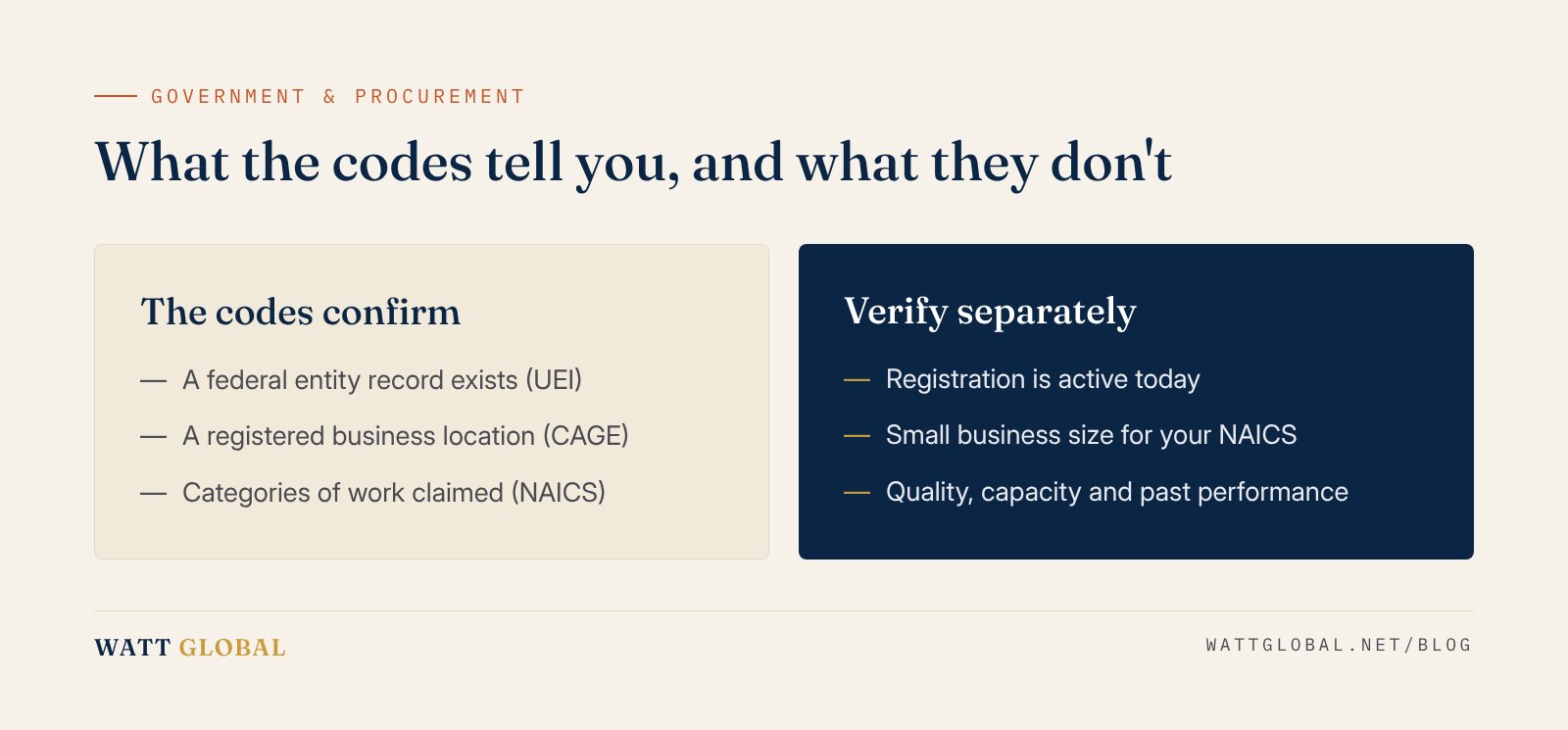
- The company has, at minimum, an entity record in the federal System for Award Management.
- You can look it up. A public entity search on SAM.gov will show the company's registration details and status.
What it doesn't tell you:
- Whether the registration is currently active. Registration for federal awards must be renewed every 365 days, so a UEI printed on a statement from last year isn't proof of an active registration today. Check SAM.gov directly.
- Anything about quality, capacity or past performance.
CAGE: where the company is
The Commercial and Government Entity (CAGE) code is a five-character identifier tied to a specific business location. For US companies, it is typically assigned as part of SAM.gov registration.
The CAGE code matters most to defense and logistics buyers, and it often appears on contract documents and in facility-related records. For most training and consulting buys, you will simply see it as a second confirmation that the company has completed federal registration. Like the UEI, it says nothing about how good the company's work is.
NAICS: what kind of work the company does
NAICS (the North American Industry Classification System) uses six-digit codes to classify types of business activity. A capability statement typically lists a primary NAICS code and several additional ones.
NAICS codes are useful to buyers in two ways:
- Fit. They signal the categories of work a company has said it performs. Leadership and workforce training firms commonly list codes such as 541611 (administrative management and general management consulting), 541612 (human resources consulting), 541618 (other management consulting), 611430 (professional and management development training) and 611710 (educational support services).
- Size status. Each solicitation is assigned one NAICS code, and that code carries the small business size standard set by the SBA. Whether a company qualifies as small for your buy depends on that code, not on how the company describes itself.
A long list of unrelated codes is worth a second look. A focused list that matches the services described on the page is a good sign.
Reading the rest of the page
The identifiers confirm eligibility. The rest of the statement tells you whether the company is a fit.
Core competencies
Look for specific services, not adjectives. "Supervisor development series, de-escalation training, instructional design" tells you more than "innovative, results-driven solutions." If the competencies are vague, the proposal probably will be too.
Differentiators
Good differentiators are concrete: a defined method, a delivery format, a specialty audience, a geographic reach. Ask yourself whether a competitor could paste the same sentence onto their own statement. If so, it isn't really a differentiator.
Past performance and experience
This section deserves careful reading. Look at whose experience is being described. Some statements list contracts the company itself performed; others describe the professional background of its founders or key staff. Both can be relevant, but they are different things, and a well-written statement makes the distinction clear. If it isn't clear, ask.
Socioeconomic status
Small business, woman-owned, veteran-owned, HUBZone and 8(a) designations matter when a solicitation is set aside. Verify any claimed status through SAM.gov or the relevant SBA program, since certifications have their own rules and renewal cycles.
Contact information
A named point of contact, a working phone number and an email address. Obvious, but often missing.
A worked example
Here is how a buyer might read WATT Global's own identifiers:
- UEI JX9JXMK5KLA9 and CAGE 249C9: the company has a federal entity record and a CAGE code. A buyer should still confirm current registration status on SAM.gov.
- Primary NAICS 541611, with 541612, 541618, 611430 and 611710: the codes cluster around management consulting, HR consulting and professional development training, which matches the services the company describes.
- Experience: WATT Global LLC was formed in November 2025. Its founder, Shawn Watt, brings more than 14 years of personal experience in frontline operations and enterprise learning at Amtrak. That is the founder's individual background, not company past performance, and a careful buyer should read it that way.
That last point is exactly the kind of distinction worth checking on any capability statement you review.
A quick checklist for buyers
Before you add a vendor to your shortlist:
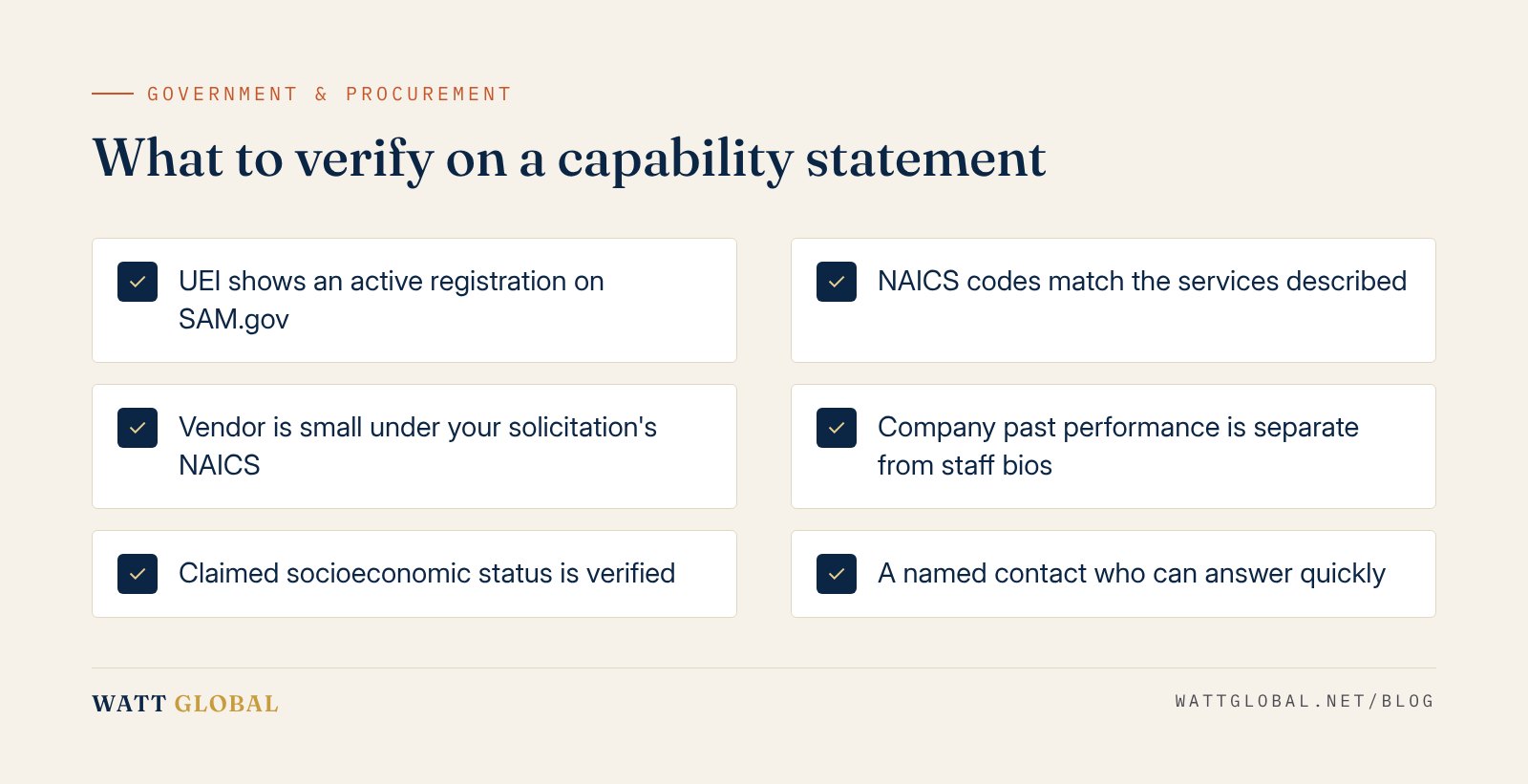
- Confirm the UEI shows an active registration on SAM.gov.
- Check that the NAICS codes match the services described.
- Note which NAICS code your solicitation will use, and whether the vendor is small under it.
- Separate company past performance from individual experience.
- Verify any socioeconomic status that matters for a set-aside.
- Make sure there is a named contact who can answer questions quickly.
From statement to conversation
A capability statement won't tell you everything about a vendor, and it isn't meant to. Read the identifiers to confirm eligibility, read the competencies and experience to judge fit, then verify what matters most at the source. The vendors worth talking to make all of this easy.
If you are researching leadership development, workforce training or procurement coordination, download WATT Global's capability statement and request a quote. If you want to understand the method behind our training first, the WATT Framework explains how we structure every engagement.