Train-the-Trainer: How to Scale Training Without Losing Quality
Train-the-trainer programs can multiply your reach or dilute your best training. Five steps to scale delivery while holding the standard.
At some point, every growing organization hits the same wall. The training works, people like it, and results improve, but there are only so many sessions one facilitator or one small L&D team can run. New hires wait weeks for onboarding. Remote sites get a watered-down version. A good program stalls because it can't reach the people who need it.
A train-the-trainer program is the usual answer: prepare skilled people inside the organization to deliver the training themselves. Done well, it multiplies your reach and builds leaders along the way. Done poorly, it turns a sharp program into a game of telephone, with each new round of trainers delivering a slightly weaker version than the last. This guide covers how to scale without that drop in quality.
Why train-the-trainer programs lose quality
Quality rarely collapses all at once. It drifts. A few common causes:
- The wrong people are chosen. Organizations often pick trainers based on availability or seniority rather than credibility and facilitation ability.
- Trainers learn the content, not the craft. Knowing the material and teaching it well are different skills. Many programs teach only the first.
- Materials are too loose. A slide deck with no facilitator guide leaves every trainer to improvise, so every session ends up different.
- No one watches the training after launch. Without observation and feedback, small changes pile up unnoticed.
- Trainers have no support. A new trainer who hits a tough room and has nobody to debrief with will quietly stop doing the hard parts.
Each of these is fixable. The fix is designing the train-the-trainer program as carefully as the training itself.
A training program is only as strong as its weakest delivery. Scale the standard, not just the slides.
Step 1: Choose trainers for credibility, not just availability
The best internal trainers are usually respected practitioners: people who do the job well and whom peers already go to for help. On frontline teams especially, credibility with the audience matters more than polish. A shift lead who has handled the situations being taught will be believed in a way an outsider sometimes isn't.
Look for:
- Strong performance in the skill being taught.
- Respect from peers, not just from management.
- Patience and genuine interest in helping others learn.
- Willingness to receive feedback on their own delivery.
- Enough protected time to prepare, deliver and improve.
That last point is often overlooked. If training is added on top of a full workload with no time set aside, quality will suffer no matter how capable the person is.
Step 2: Teach the craft, not just the content
Your future trainers need two things: deep command of the material and the skills to facilitate it. Plan for both.
Content mastery
Trainers should go through the program as participants first, then study it as teachers. They need to understand not only what each section says but why it's there, what it's meant to change, and which parts can flex without losing the point.
Facilitation skills
This is where most programs fall short. Strong facilitation includes:
- Opening a session so people feel safe to participate.
- Asking questions that get real answers, then waiting for them.
- Running practice activities and role-plays with clear instructions.
- Handling skeptics, side conversations and people who dominate.
- Giving useful feedback to learners during practice.
- Managing time so the most important practice isn't cut short.
The best way to build these skills is the same way adults learn anything: practice with feedback. Every trainer should "teach back" sections of the program to peers and an experienced facilitator before running a live session.
Step 3: Build materials that hold the standard
Good materials are what keep session 50 as strong as session 1. At a minimum, each module should include:
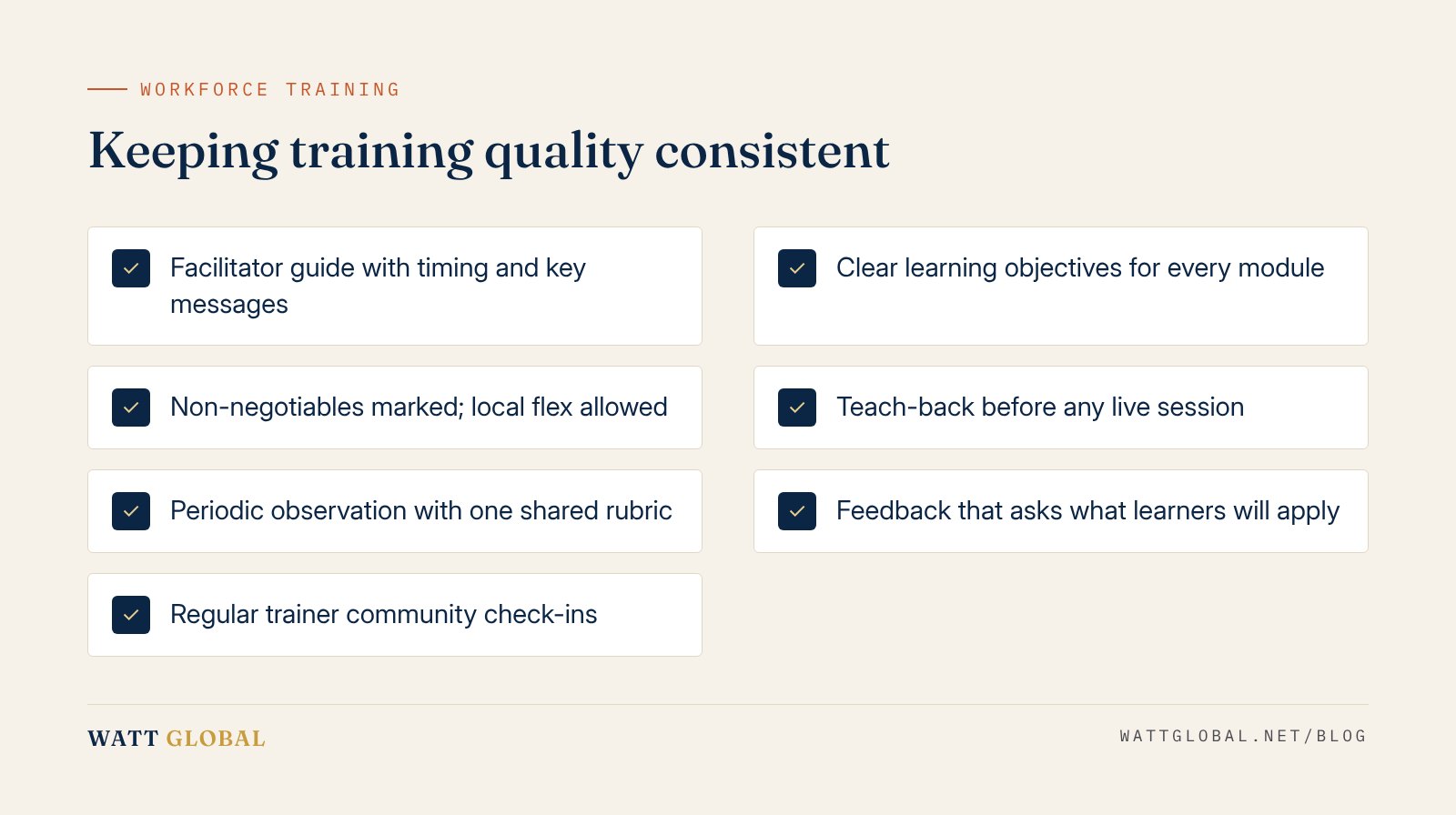
- A facilitator guide with timing, key messages, questions to ask, and notes on common sticking points.
- Clear learning objectives so every trainer knows what success looks like.
- Practice activities with instructions detailed enough that two trainers would run them the same way.
- Participant materials that reinforce the key points after the session.
- A short list of non-negotiables, the parts that must be delivered as written, and permission to adapt the rest to the local audience.
That balance between fixed and flexible is the heart of scaling well. Too rigid, and trainers sound scripted. Too loose, and the program drifts.
Step 4: Launch in phases, with support
Don't certify a group of trainers and send them off. Bring them in gradually, with more support at the start.
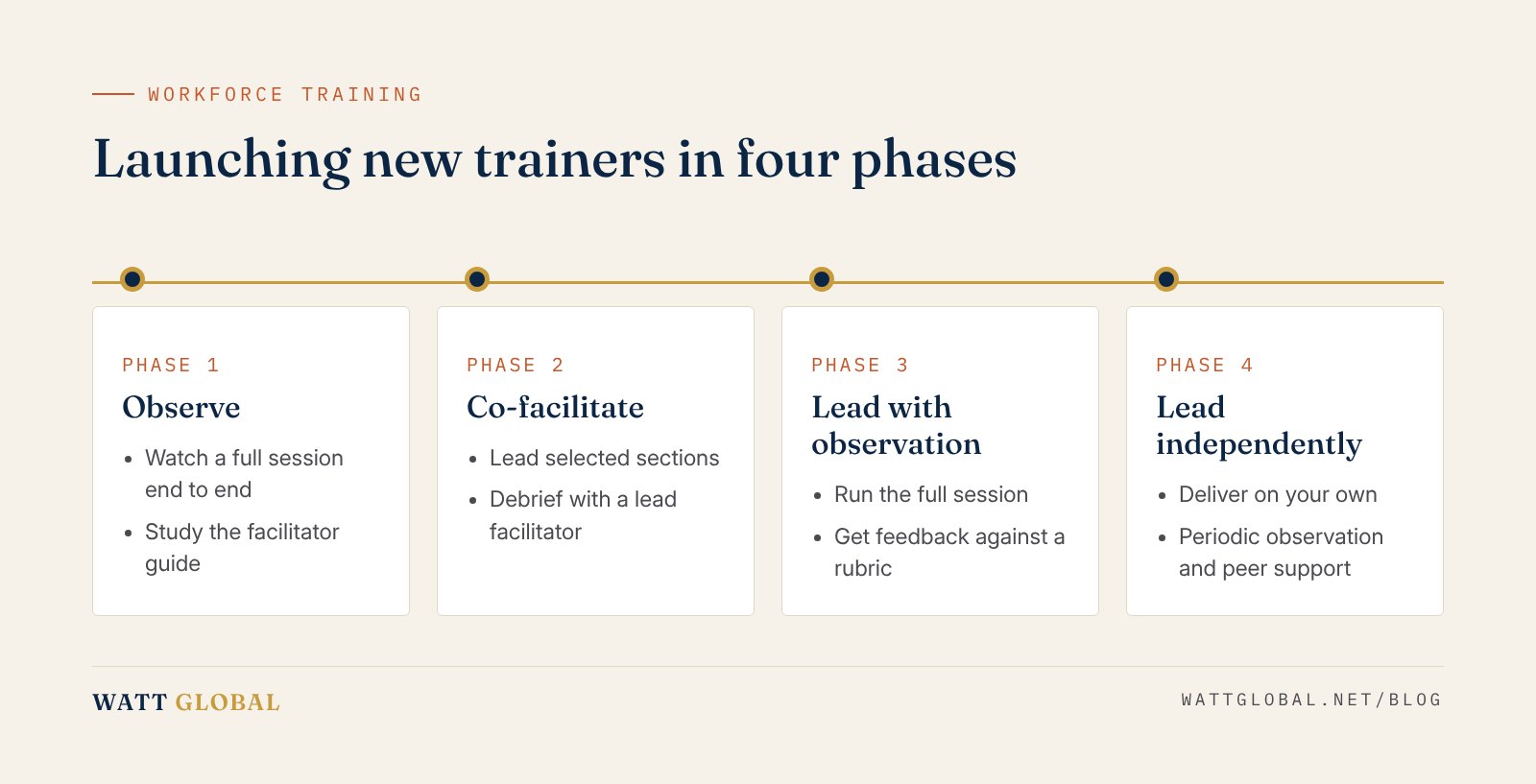
A typical progression looks like this:
- Observe: the new trainer watches an experienced facilitator deliver the full program.
- Co-facilitate: they deliver selected sections alongside an experienced facilitator.
- Lead with observation: they run the full session while an experienced facilitator observes and gives feedback.
- Lead independently: they deliver on their own, with periodic observation and a peer network to call on.
The pace can vary with the complexity of the material. A de-escalation or safety-related program deserves more observed sessions than a short introductory module.
Step 5: Keep quality visible
After launch, quality needs ongoing attention. Build in a few simple checks:
- Periodic observation of every trainer, using the same short rubric each time.
- Participant feedback that asks about application, not just enjoyment: "What will you do differently this week?"
- Trainer community check-ins where trainers share what's working, what's hard and what they've changed.
- A regular content review so updates reach every trainer at the same time.
These checks also give you the evidence to show the program is working, which matters when budgets come up for review.
Where experience helps
Designing and running a train-the-trainer program is its own discipline. WATT Global's founder, Shawn Watt, spent more than 14 years at Amtrak in frontline operations and enterprise learning, including national training and facilitation, onboarding, de-escalation and instructional design. That personal experience, building and delivering training for large, distributed frontline teams, shapes how we approach scaling programs today.
Our workforce training services include train-the-trainer design and delivery, along with the facilitator guides, practice activities and quality checks that keep programs consistent. It all follows the Training stage of the WATT Framework: practice the skill, then build the habit. You can see the full range of workforce training and consulting services on our site.
The takeaway
A train-the-trainer program is how a good training program reaches everyone who needs it. Quality holds when you:
- choose credible trainers and give them time,
- teach facilitation, not just content,
- build materials that separate the non-negotiables from what can flex,
- launch in supported phases, and
- keep observing and improving after launch.
Get those right and every new trainer strengthens the program instead of diluting it.
If you're ready to scale a training program across sites or shifts, talk with us about a train-the-trainer program built around your people and your standards.