De-Escalation Training for Customer-Facing Teams: What Good Programs Include
What separates de-escalation training that changes frontline behavior from a slide deck watched once a year, plus the questions to ask before you buy.

Every customer-facing employee eventually meets the moment nobody wants: a passenger who has missed the last connection, a patient's family member who has waited four hours, a guest whose room is not ready and who has decided the person at the desk is the reason. What happens in the next sixty seconds depends far less on policy than on what that employee has practiced.
De-escalation training is how organizations give people that practice. But the label covers everything from a slide deck watched once a year to a program that changes how frontline teams actually behave under pressure. If you are about to buy, build or renew one, this guide covers what good programs include and the questions worth asking before you sign.
Why de-escalation is now an operations issue
For a long time, handling upset customers was treated as a soft skill people either had or didn't. Operators in high-contact industries have moved past that view. Transit agencies are a useful example because their frontline staff face the public in tight spaces, on a schedule, often alone.
Santa Clara VTA trained more than 1,300 frontline staff with an eight-hour de-escalation program repeated every three years, NJ Transit expanded conflict de-escalation training for its conductors, and the American Public Transportation Association published a recommended practice on the subject (SS-SEM-RP-020-25). The pattern is the same in healthcare, hospitality and utilities: de-escalation is being treated as a core operating skill, scheduled and refreshed like any other.
The reason is practical. A tense interaction that goes badly costs time, morale, sometimes safety, and often a customer. One that goes well usually costs nothing at all, because nobody notices it.
What de-escalation training is (and what it isn't)
Good de-escalation training teaches employees to lower the emotional temperature of an interaction so a problem can be solved, or so the situation can be handed off safely. It is a communication and judgment skill.
It is not:
- Self-defense or physical intervention training. Those are separate disciplines with their own requirements. A de-escalation program should be clear about where its scope ends.
- A script. Scripts help new staff find words, but people under pressure can hear when they are being read to. Scripts are a starting point, not the skill.
- A one-time event. A single session creates awareness. Skill comes from repetition, which is why the strongest programs build in refreshers.
Calm is not a personality trait. It is a skill people can practice until it shows up when they need it.
What good programs include
When you compare programs, look for these components. Most weak programs are missing at least three of them.
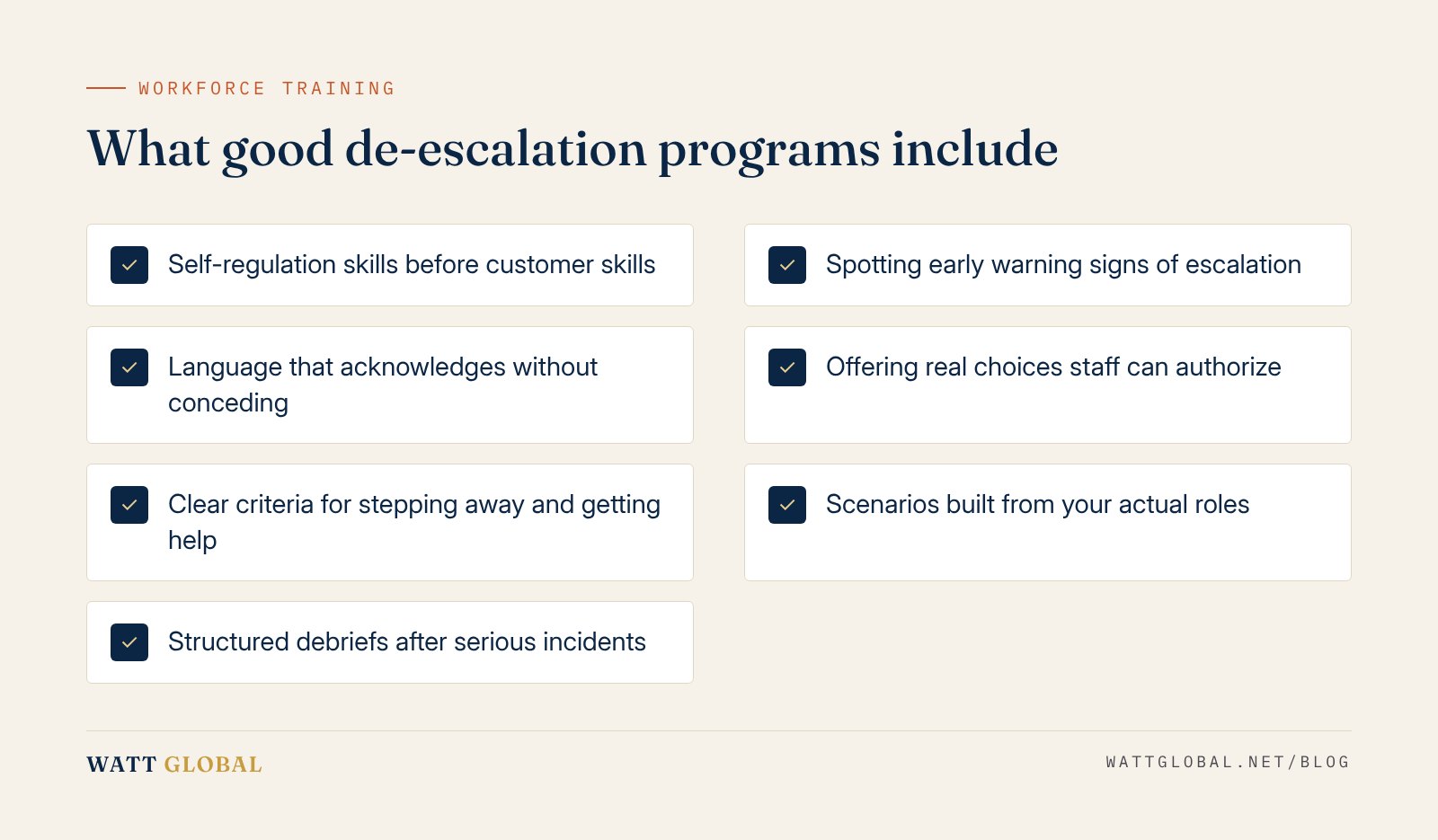
- Self-regulation first. Employees can't calm someone else while their own heart rate is climbing. Good programs teach simple ways to notice and steady your own reaction before you respond.
- Early warning signs. Raised voice, repeated questions, pacing, a sudden silence. Teams learn to spot escalation early, when it is easiest to redirect.
- Language that acknowledges without conceding. Phrases like "You've been waiting a long time, and that's frustrating" validate the feeling without promising what you can't deliver.
- Offering real choices. People calm down when they regain some control. Training should help staff identify the options they genuinely have the authority to offer.
- Knowing when to step away and get help. Clear criteria for disengaging, calling a supervisor or contacting security, tied to your existing policies.
- Role-specific scenarios. A bus operator, a front-desk agent and a field technician face different situations. Practice should use the situations your people actually meet.
- After-incident support. A brief, structured debrief helps employees recover and helps the organization learn.
Practice beats presentation

The most common failure in de-escalation training is too much talking about de-escalation and too little doing it. Adults keep skills they rehearse, not skills they hear described.
Build the session around scenarios
A strong session spends most of its time on short, realistic scenarios. Picture a hypothetical shift where a front-desk agent practices the same difficult check-in three times: once cold, once after a coaching tip, once with a twist the facilitator adds. By the third round, the agent's words are their own.
Keep modules short and repeatable
Long sessions are hard to schedule for shift-based teams. Shorter modules, such as 45-minute blocks that fit inside a shift change or a team meeting, are easier to repeat. WATT Global's "Better Conversations in the Moment™" module is built on that idea: a focused block of practice that teams can run again as a refresher rather than a once-a-year event.
Plan the refresh cycle up front
Decide before launch how often staff will practice again, whether that is quarterly huddles, annual refreshers or a multi-year full retraining cycle like the one VTA adopted. If the refresh isn't scheduled, it usually doesn't happen.
The supervisor's role
Frontline employees take their cues from their supervisors. If a supervisor rolls their eyes at the training, or never asks about it again, most of its value disappears within weeks.
Good programs give supervisors three specific jobs:
- Model it. Use the same language and approach in their own interactions, including with staff.
- Reinforce it. Ask "What worked?" after a tough interaction, not only "What went wrong?"
- Debrief it. Run a short, blame-free conversation after serious incidents, and pass patterns back to whoever owns the training.
For this reason, it is worth including supervisors in the same sessions as their teams, plus a short additional block on coaching and debriefing.
Questions to ask before you buy
Whether you are writing a solicitation or comparing vendor proposals, these questions separate substantive programs from generic ones:
- How much of the session time is spent in active practice versus presentation?
- Will scenarios be adapted to our roles, locations and policies? Who does that work?
- How does the program connect to our existing incident reporting and escalation procedures?
- What do supervisors receive beyond the frontline course?
- What is the recommended refresh cycle, and what materials do we keep for it?
- How will we know it's working? Which indicators will we review, and when?
That last question matters most. Agree up front on what you will look at: incident reports, customer complaints, employee confidence ratings or supervisor observations. Then check them at a set point after delivery. This is the Transformation stage of the WATT Framework: reviewing progress against agreed goals rather than assuming the training worked because people liked it.
Making the purchase straightforward
Many organizations that need de-escalation training, including transit authorities, public health systems and municipal service departments, buy it through a formal procurement process. If that is your situation, describe the audience size, roles, locations, preferred format and refresh expectations in your requirements. The clearer the scope, the more comparable the proposals you receive.
WATT Global designs and delivers de-escalation and customer experience training for frontline teams, and coordinates the logistics around it when agencies need a single point of contact.
Ready to equip your frontline teams
De-escalation is not a talent a few employees happen to have. It is a set of skills your whole frontline can learn, practice and keep, as long as the program is built around realistic practice, supported by supervisors and refreshed on a schedule.
If you are scoping a program for an agency or a customer-facing workforce, request a de-escalation training quote with your audience, locations and timeline, and we will come back with a delivery approach that fits.