Designing 45-Minute Training Modules Adults Actually Remember
A focused 45-minute module can change more behavior than a full day of slides. Here's how to design one adults will remember and use.
Most workplace training has a memory problem. People sit through a half-day session, nod along, maybe enjoy it, and a week later can recall almost nothing they'd actually use. That isn't a failing of the learners. It's usually a design problem: too much content, too little practice, and nothing that connects the session to the work people go back to.
Good instructional design for adult learners starts from a different question. Not "What do we need to cover?" but "What should people be able to do differently on Monday?" Answer that well, and a focused 45-minute module can change more behavior than a full day of slides. Here's how to design one.
Why 45 minutes works
There's nothing magic about the number, but a 45-minute block has real practical advantages for organizations:
- It fits the workday. It can run at the start of a shift, during a team meeting slot or over a long lunch, without pulling people off the floor for half a day.
- It forces focus. With 45 minutes, you can't cover everything. You have to choose the one skill that matters most, which is exactly the discipline most training lacks.
- It's repeatable. Short modules can be delivered to many groups, scheduled around shifts, and spaced over weeks so each one builds on the last.
- It's easier to scale. A tight module with a clear structure is far easier for internal facilitators to deliver consistently.
The tradeoff is that a 45-minute module can't teach a whole discipline. It teaches one skill well. A series of focused modules, spaced over time, will usually do more than one long session.
If you can't say what people will do differently next week, the module isn't ready to teach.
Principles of instructional design for adult learners
Adults learn best when the learning respects what they already know and connects directly to the problems they face. A few principles guide every strong module.
Start from the job, not the topic
Define the outcome as an observable behavior. "Understand de-escalation" is a topic. "Use a calm opening question when a customer raises their voice" is a behavior. The second tells you what to teach, what to practice and how to tell if it worked.
Use their experience
Adults bring years of relevant experience into the room. Good modules draw it out: ask people to describe a recent situation, compare approaches, or name what has and hasn't worked for them. This makes the material feel relevant and lets learners teach each other.
Make practice the main event
People remember what they do far better than what they hear. In a strong module, practice takes up a large share of the time, with real scenarios, role-plays, or applying a tool to a live problem. Explanation should be just long enough to set up the practice.
Keep the load light
Every extra model, acronym and slide competes for limited attention. Teach one framework, a handful of key moves, and nothing else. If something is "nice to know," leave it in a handout.
Plan what happens after
A module ends at minute 45, but learning shouldn't. Build in a small commitment, a reminder, or a follow-up check-in that brings the skill back into the workweek.
The anatomy of a 45-minute module
Here's a simple structure that works for most skills. The timings are a guide, not a rule.
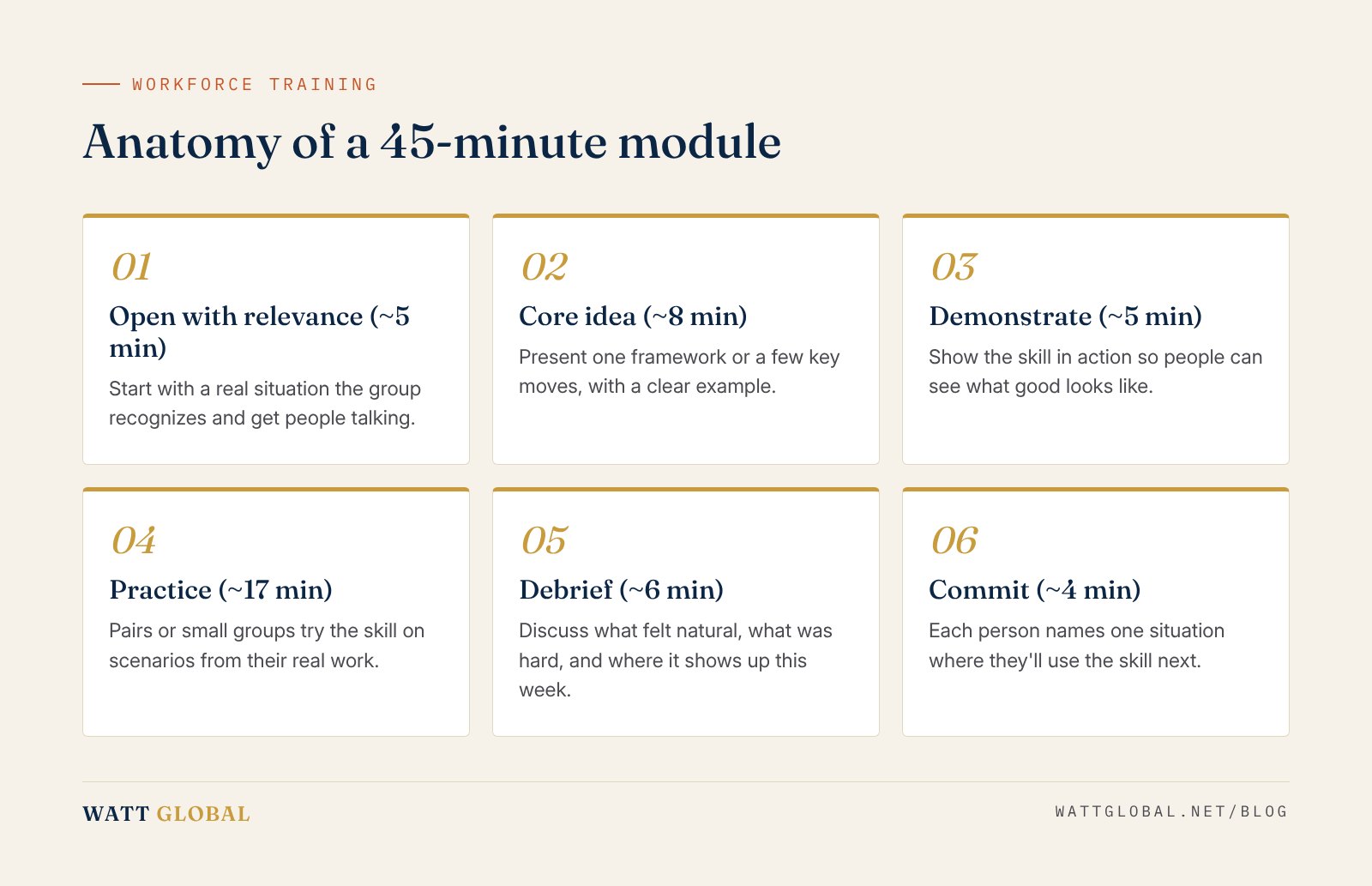
- Open with relevance (about 5 minutes). Start with a real situation the group recognizes. Ask a question that gets people talking about their own experience.
- Introduce the core idea (about 8 minutes). Present one framework or a few key moves, with a clear example. Keep it brief.
- Demonstrate (about 5 minutes). Show the skill in action, live or through a short scenario, so people can see what "good" looks like.
- Practice (about 17 minutes). Learners try the skill in pairs or small groups, using scenarios drawn from their actual work. The facilitator circulates and gives feedback.
- Debrief (about 6 minutes). What felt natural? What was hard? Where will this show up this week?
- Commit (about 4 minutes). Each person names one specific situation where they'll use the skill before the next session.
Notice that practice and debrief together take roughly half the module. That's deliberate.
Making it stick after the session
The best 45 minutes in the world will fade if nothing reinforces it. Plan the follow-through as part of the design:
- Spacing: schedule related modules a week or two apart so each one revisits the last.
- Manager reinforcement: give supervisors two or three questions to ask in team huddles ("Who used the opening question this week? How did it go?").
- Job aids: a pocket card or a one-page reminder of the key moves, kept where the work happens.
- Quick check-ins: a short follow-up at the next team meeting to share what worked.
This mirrors the logic of the WATT Framework: Training builds the habit through practice, and Transformation reviews progress against agreed goals and applies what you learn. A module is the start of that cycle, not the whole of it.
A design checklist
Before you deliver a new module, run it against this list.

- One observable behavior is named as the outcome.
- The opening connects to a situation learners recognize.
- Only one framework or set of moves is taught.
- Practice takes up a large share of the time.
- Scenarios come from the learners' real work.
- There's a clear debrief and personal commitment.
- A follow-up or reinforcement step is planned.
- A facilitator guide exists so others can deliver it consistently.
If a module fails more than one or two of these, it's worth revising before it reaches a room.
How we build modules at WATT Global
Short, practical modules are central to how WATT Global designs training. Our three 45-minute modules, Better Conversations in the Moment™, Conflict to Connection™ and Speak Up, Listen In™, each focus on one set of communication skills and give most of their time to practice. They're built to be delivered to teams on their own or as a connected series.
We also offer instructional design consulting for organizations that want to build their own modules, whether that's onboarding, customer experience or de-escalation training. That work often starts with a performance gap analysis: what should people be doing, what are they doing now, and is training actually the right fix? You can see the full range on our solutions page.
The takeaway
Instructional design for adult learners comes down to respect: for people's time, their experience and the real work they go back to. A well-designed 45-minute module chooses one skill, connects it to the job, makes practice the main event and plans what happens next. That's how training stops being an event people sit through and becomes something they use.
If you'd like help designing training your people will actually remember, or want to bring one of our modules to your team, get in touch with us. We'll start with the behavior you want to change and work backward from there.