Employee Onboarding That Keeps People: A 30-60-90 Framework
A practical employee onboarding plan for the first three months: learn the place, contribute to the work, then own a piece of it.

Most onboarding programs are designed for the first week and abandoned by the third. The laptop works, the benefits forms are signed, the new hire has met the team over coffee, and then the calendar fills up and everyone assumes they will figure out the rest. Many do. Some quietly start wondering whether they made the right choice.
An employee onboarding plan that keeps people looks past orientation. It treats the first three months as a deliberate sequence: learn the place, contribute to the work, then own a piece of it. Here is a practical 30-60-90 framework you can adapt for almost any role, from a frontline team member to a new department lead.
Why onboarding deserves more than a week
The first months set a new hire's expectations for everything that follows: how decisions get made, whether questions are welcome, whether their manager is paying attention. Those early impressions are hard to undo.
There is also a broader engagement problem to solve. Gallup reports that global employee engagement fell to 20% in 2025, and that manager engagement dropped from 30% to 27% in 2024 (Gallup, State of the Global Workplace). A new hire's manager is the single most important part of their onboarding, and many managers are stretched thin themselves. A clear framework takes some of that weight off them by making the next step obvious.
Onboarding is not paperwork. It is the first promise your organization makes, and the first one people check you on.
Before day one: the preboarding window
The weeks between an accepted offer and a start date are often silent. Use them.
- Send a short welcome note from the manager, not just HR, with what the first day will look like.
- Have equipment, system access and a workspace ready before the person arrives.
- Assign an onboarding buddy who is not the new hire's manager.
- Share two or three things to read, and say clearly that nothing else is expected yet.
- Put the 30-, 60- and 90-day check-ins on both calendars now.
That last step matters more than it looks. Check-ins that are already scheduled happen. Check-ins that depend on someone remembering usually don't.
The 30-60-90 framework
The structure below gives each phase a clear purpose. The details will change by role, but the shape holds.
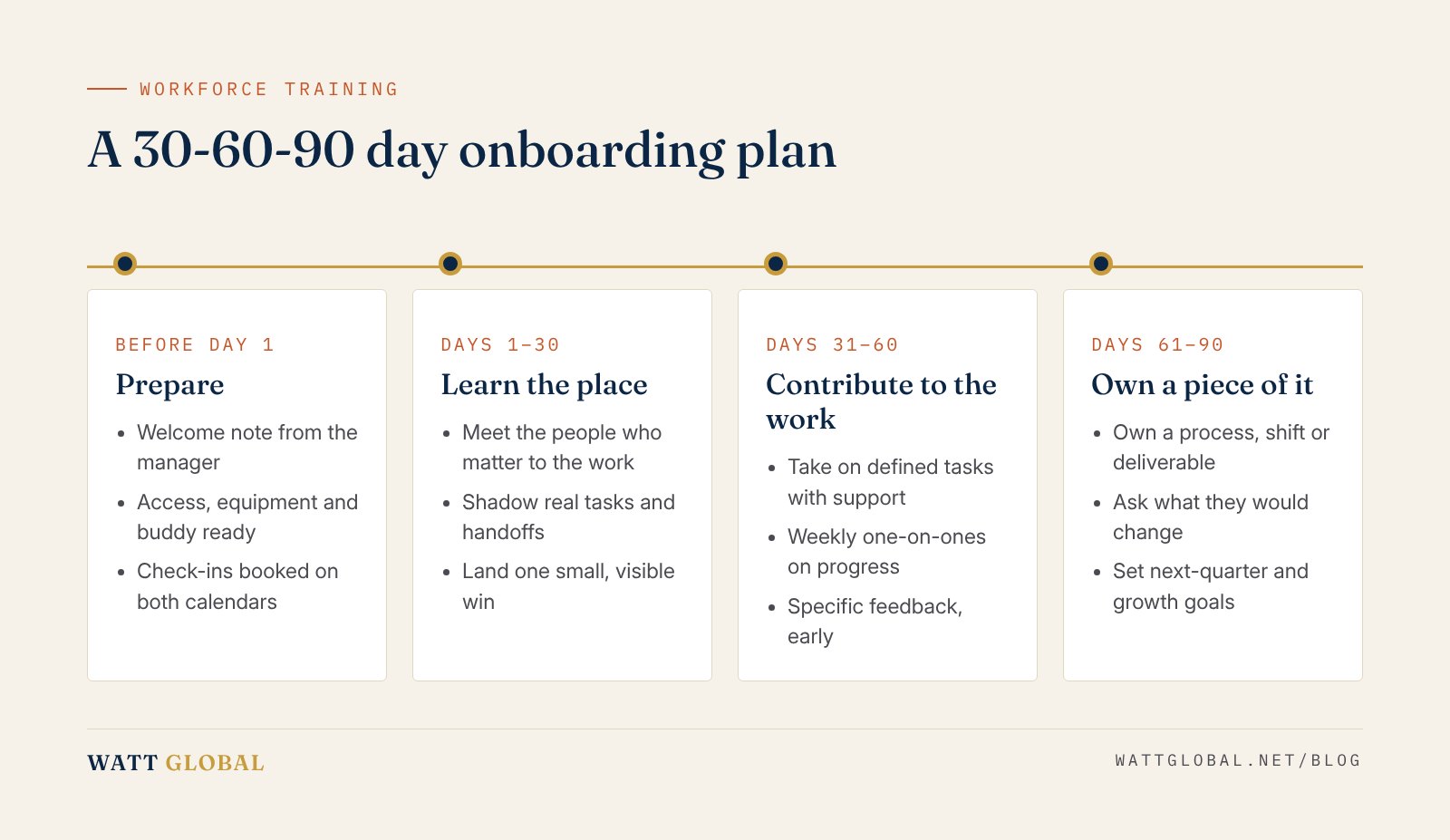
Days 1–30: Learn the place
The goal of the first month is understanding, not output. A new hire who spends this month listening will make better decisions later.
- Meet the people who matter to the work. Give them a short list of colleagues to meet, with a note on why each one matters.
- Learn how work actually gets done. Shadowing beats documentation. Let them watch real tasks, real meetings and real handoffs.
- Complete required training, but spread it out so it isn't a wall of modules in week one.
- Get one early, visible win. Something small and real, so they know their work counts.
At the 30-day check-in, ask: What has surprised you? What is still unclear? What do you need that you don't have?
Days 31–60: Contribute to the work
Now the new hire takes on real responsibilities with support close at hand.
- Hand over defined tasks or a small project with clear success criteria.
- Shift the buddy relationship from "show me" to "check my thinking."
- Start regular one-on-ones with the manager focused on progress, not just status.
- Give specific feedback early, both what is working and what needs adjusting.
At the 60-day check-in, review the goals set at day 30. Adjust them if the role has turned out differently from what the job description promised. It often does.
Days 61–90: Own a piece of it
By the third month, the new hire should own something outright: a process, a set of accounts, a shift, a recurring deliverable.
- Agree on the outcomes they are responsible for over the next quarter.
- Ask them what they would change, now that they have seen how things work. Fresh eyes are a short-lived asset.
- Discuss development: what skill would make the biggest difference in the next six months?
At the 90-day check-in, the conversation should feel less like onboarding and more like a regular performance and growth discussion. That shift is the point.
Making the framework work for frontline roles
Thirty-day phases can look too slow for roles where people are fully on the floor by week two. The framework still applies; the content inside each phase changes.
Picture a hypothetical new customer service representative at a utility. In days 1–30, they handle live calls with a coach listening in and a short daily debrief. In days 31–60, they take calls independently but review two recordings a week with their supervisor, including at least one difficult interaction. In days 61–90, they start helping the next new hire, which is often the moment their own confidence locks in.
For frontline teams, two additions make the biggest difference: early practice in handling upset customers, and a supervisor who checks in briefly and often rather than at length and rarely.
The manager's checklist
The framework only works if the manager runs it. A short checklist keeps it realistic:
- Before day one: welcome note sent, buddy assigned, check-ins on the calendar.
- Week one: daily five-minute touchpoint.
- Each phase: goals written down and shared with the new hire.
- Each check-in: ask before you tell. Their questions reveal what the plan missed.
- Day 90: agree on next-quarter outcomes and one development goal.
If your managers are new to the role themselves, this checklist doubles as a lesson in the basics of leading people. Many organizations pair onboarding redesign with manager training for exactly that reason.
Measuring whether onboarding is working
You don't need a data team to tell whether onboarding is improving. Choose a few indicators you already track and review them every quarter:
- How many new hires are still with you at 90 days and at one year.
- How long it takes new hires to reach full productivity, by the measure your team already uses.
- What new hires say in a short survey at 30 and 90 days.
- What managers say about readiness at the 90-day check-in.
Agree on these before you change anything, so you are comparing against a real baseline. This mirrors the Transformation stage of the WATT Framework: progress is reviewed against goals that were set up front, not judged by how the program felt.
Build onboarding that lasts past orientation
A 30-60-90 onboarding plan gives new hires a clear path and gives managers a simple structure to follow. Learn, contribute, own: each phase builds on the last, and each check-in turns guesswork into a conversation.
WATT Global helps organizations redesign onboarding, from the new-hire experience to the manager training that holds it together, as part of our workforce training services. If you would like a second set of eyes on your current process, start a conversation with our team and tell us where new hires tend to get stuck.