Psychological Safety at Work: What It Is, What It Isn't and How Leaders Build It
Psychological safety isn't niceness or lower standards. Here's what the research says it is, and the everyday leader behaviors that build it.

Psychological safety at work has become one of those phrases everyone uses and few people define the same way. To some leaders it sounds like a promise that nobody will ever feel uncomfortable. To others it sounds like a soft extra, something to look at once the real work is done.
Both readings miss the point. Psychological safety is a working condition. It decides whether the people closest to a problem say so early, while it is still cheap to fix, or stay quiet until it turns into an incident, a lost customer or a resignation. This guide covers what it is, what it isn't, and the specific things leaders do, week after week, to build it.
What psychological safety actually means
The term comes from organizational research, most closely associated with Harvard professor Amy Edmondson. In her 1999 study of 51 work teams in a manufacturing company, she described team psychological safety as a shared belief that the team is safe for interpersonal risk-taking. Put simply, people believe they can ask a question, admit a mistake, raise a concern or offer an unfinished idea without being embarrassed, punished or written off.
Two details in that definition matter.
First, it is shared. It belongs to the team, not to one confident person. A team can have one outspoken member and still be unsafe for everyone else.
Second, it is about interpersonal risk. The question is not "Do people feel good here?" It is "Will people take the small social risks that learning requires?"
Edmondson's study found that psychological safety predicted learning behavior, things like asking for help, seeking feedback and talking openly about errors, and that learning behavior in turn predicted team performance. That chain is the business case. Safety does not lift results directly. It makes learning possible, and learning is what lifts results.
What it isn't
Most resistance to psychological safety comes from mistaking it for something else. Here is what it is not.
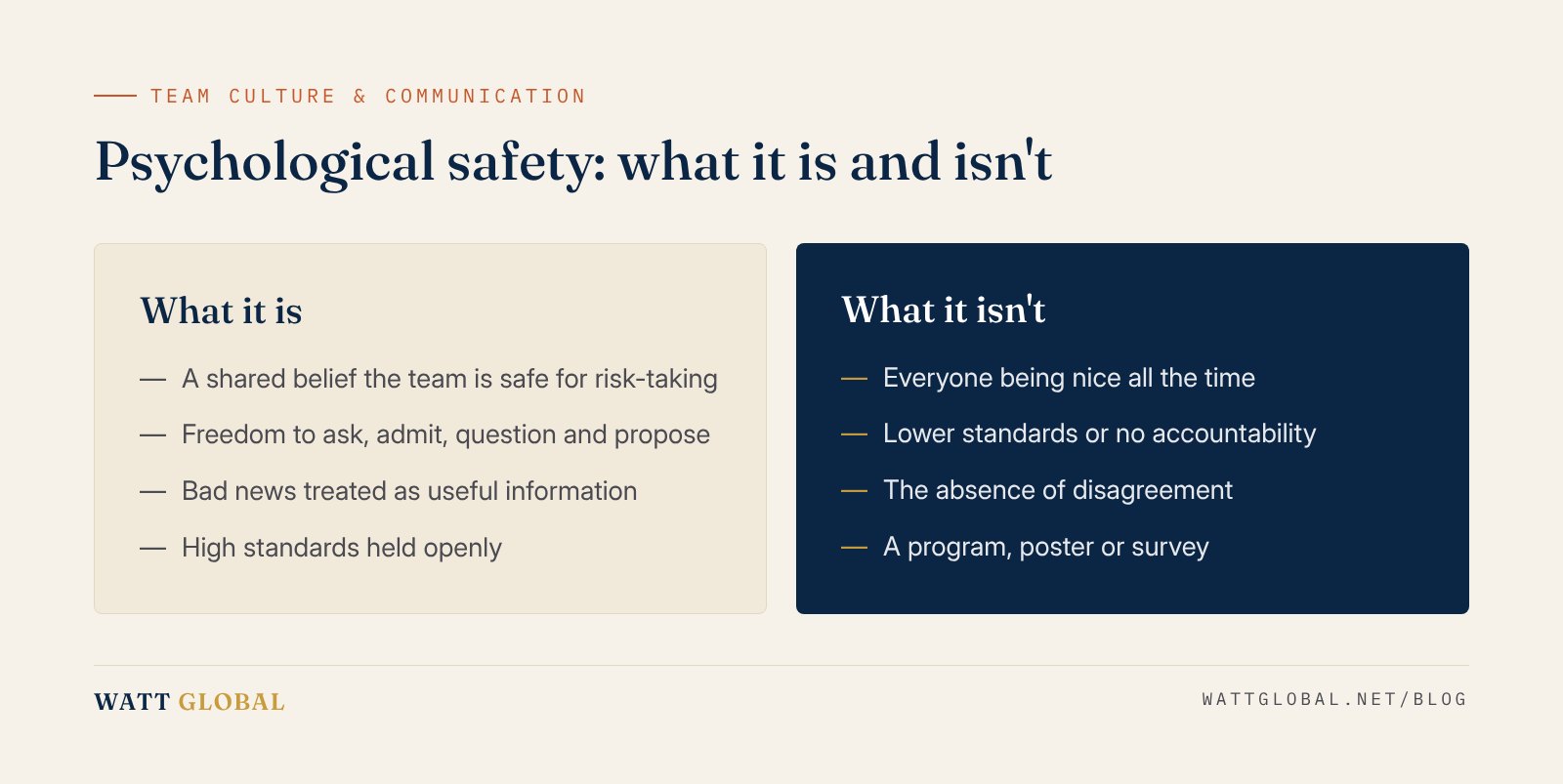
- It isn't niceness. Polite teams can be deeply unsafe. If everyone smiles in the meeting and complains in the parking lot, you have courtesy, not safety.
- It isn't lower standards. High standards and high safety work together. The goal is a team that holds a demanding bar and tells the truth about how far it is from that bar.
- It isn't the absence of conflict. Safe teams often disagree more openly, because disagreement no longer feels dangerous.
- It isn't protection from consequences. People are still accountable for their work. What changes is that honest reporting of a problem is treated as useful information, not as a confession.
- It isn't a program. You cannot roll it out with a poster or a survey. It is built, or eroded, in hundreds of ordinary moments.
Safety is not the reward for a high-performing team. It is the ground a high-performing team stands on.
Why leaders should care now
When people stay quiet, the costs rarely show up on a single line of a report. They show up as rework, near-misses that nobody logged, customer complaints that frontline staff saw coming, and good people who quietly disengage.
Engagement data shows how much is at stake. Gallup's State of the Global Workplace reports that global engagement fell to 20% in 2025 and estimates the cost of low engagement at about $10 trillion, roughly 9% of global GDP. Psychological safety is not the only factor behind those numbers, but a team where people feel they cannot speak up is unlikely to be an engaged one.
Managers carry most of this weight. The same Gallup research found manager engagement fell from 30% to 27% in 2024. Ask a tired, under-supported manager to build a climate of candor and you are asking a lot. That is why the next sections focus on small, repeatable behaviors rather than big initiatives.
How leaders build it: the everyday behaviors
Psychological safety grows when people take a small risk and the response tells them it was worth it. Leaders shape that response more than anyone else in the room. Here are the behaviors that matter most.
1. Frame the work as uncertain
People speak up more when they understand the job requires it. Before a project, a shift or a change rollout, say plainly what you don't know: "This is new for all of us. We will hit problems we haven't predicted, and I need to hear about them early." That sentence turns raising a concern from criticism into part of the job.
2. Ask real questions, then wait
"Any questions?" at the end of a meeting rarely gets an answer. Specific questions do better: "What is the weakest part of this plan?" "Where do you think this will break on the night shift?" Then stay quiet long enough for someone to answer. Silence feels long to the leader and normal to everyone else.
3. Respond to bad news with thanks first
The first reaction to bad news teaches the whole team what speaking up costs. If the first thing out of your mouth is "Who did this?", people will remember. Start with "Thank you for flagging it," then move to the problem. Accountability can follow; it just shouldn't come first.
4. Go first on mistakes
When a leader names their own misjudgment ("I underestimated how long this would take, and that's on me"), they make it safer for everyone else to do the same. Keep it short and factual. The point is to model, not to perform.
5. Close the loop
Nothing kills candor faster than speaking up and hearing nothing back. When someone raises an issue, tell them what happened next, even if the answer is "We looked at it and decided not to change course, and here's why."
Signs your team is (and isn't) safe
You can't measure psychological safety perfectly from the outside, but you can watch for signals.
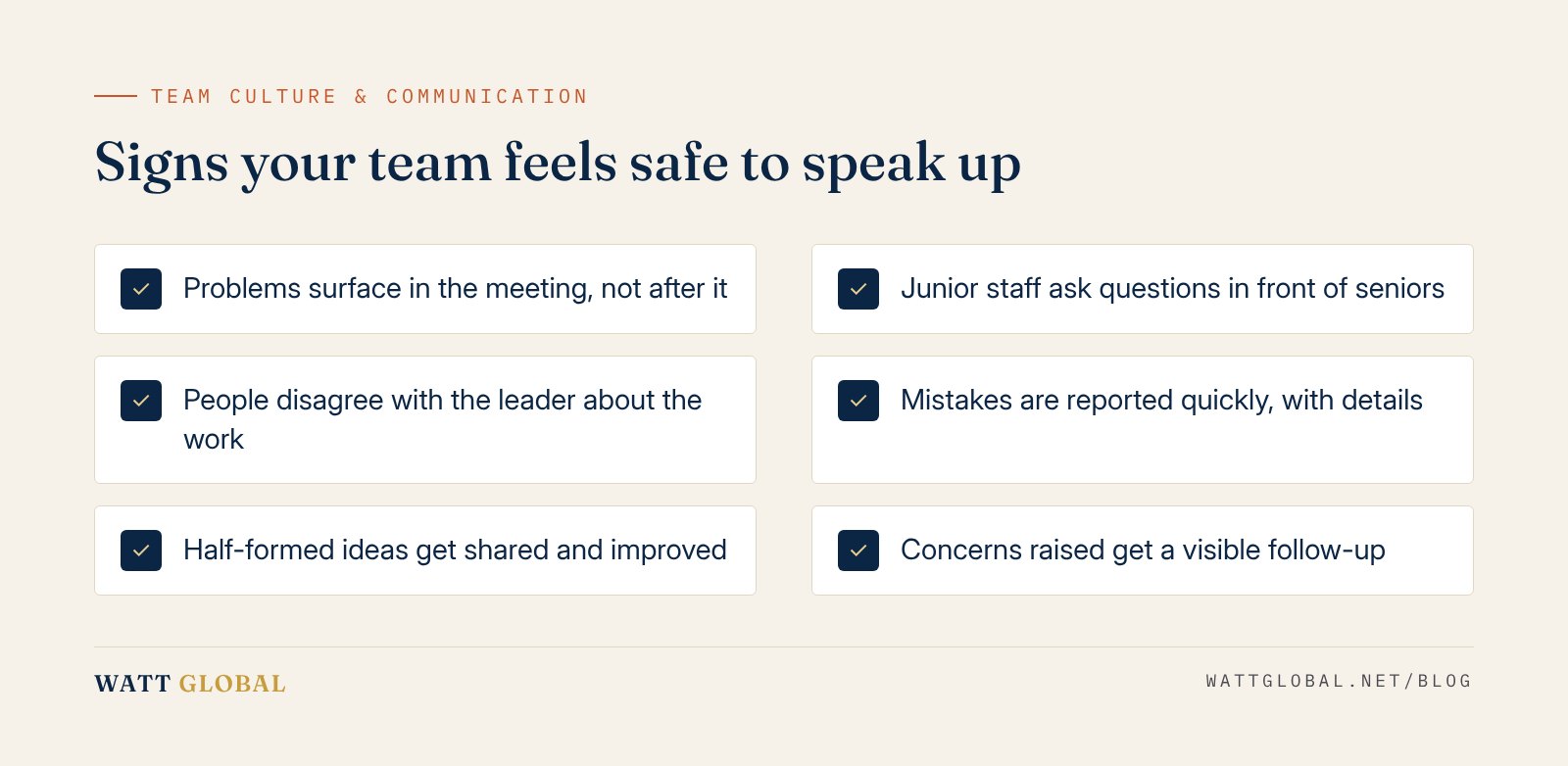
Encouraging signs:
- Problems surface in meetings, not in hallway conversations afterward.
- Junior staff ask questions in front of senior staff.
- People disagree with the leader and the conversation stays on the work.
- Mistakes are reported quickly, with details.
- Ideas arrive half-formed, because people trust the team to help shape them.
Warning signs are the reverse: meetings where only the leader talks, surprises that "everyone knew about," and post-mortems that hunt for a person instead of a cause.
This is where the Awareness stage of the WATT Framework comes in. Awareness means recognizing patterns, listening and understanding the impact you have, and that includes your own effect on whether people speak up. Most leaders overestimate how safe their team feels, because the people who feel unsafe are, by definition, the ones not telling them.
Where to start this week
You don't need a new initiative. Pick two behaviors and practice them deliberately for a month.
- In your next team meeting, name one uncertainty out loud and ask one specific question about risk.
- The next time someone brings you bad news, say thank you before anything else.
- At the end of the week, close the loop on one concern someone raised.
Then ask your team, privately or anonymously, one simple question: "Is it easier or harder to raise a problem here than it was a month ago?" Their answer is more useful than any poster.
If you want structured practice for a whole team, this is the work WATT Global's team and culture workshops are built around. Short, practical sessions such as Speak Up, Listen In™ give people a shared language for raising concerns and responding well.
The bottom line
Psychological safety isn't softness, and it isn't optional. It decides whether your organization learns from the people closest to the work or keeps finding out too late. Leaders build it through framing, asking, responding and closing the loop, over and over, in ordinary moments.
If you'd like help building a team where people tell you the truth early, talk with us about your team. We'll start with where things stand today and what you want to change.