Better Conversations in the Moment: Five Questions That Lower the Temperature
Most difficult conversations at work happen without warning. Five simple questions can slow things down and turn a tense moment into a useful one.

Most advice about difficult conversations at work assumes you get to prepare. Book a room, plan your opening line, rehearse the hard part. That helps for a scheduled performance talk. It doesn't help when a colleague snaps at you in a meeting, a customer raises their voice at the counter, or a team member pushes back hard on a decision you announced five minutes ago.
Those are the conversations that shape a workplace, and they happen in the moment. You have seconds, not days. The good news is that you don't need a script. You need a small set of questions you can reach for when the temperature rises, questions that slow things down, show respect and move the conversation toward something useful.
Why in-the-moment conversations go wrong
When a conversation turns tense, most of us fall into one of two habits. We push: defend, explain, correct, win the point. Or we retreat: go quiet, agree to end it, and carry the frustration into the next interaction.
Both habits make sense in the moment. Both usually make things worse. Pushing raises the other person's guard. Retreating leaves the real issue untouched, so it comes back larger.
What's missing in both cases is curiosity. A good question does three things at once: it buys you time to think, it signals that you are listening, and it gives the other person a chance to say what's actually going on. That is why questions, not statements, are the most reliable tool for lowering the temperature.
Plenty of managers find this hard. In LifeLabs Learning's 2026 mid-year trends research, drawing on more than 20,000 people, 56% rated their manager's coaching and feedback capability at 5 out of 10 or lower, and only 14% rated it 8 to 10. These skills can be learned, but most people have never been taught them.
You don't have to win the moment. You have to keep it from getting worse, and leave room to get it right.
The five questions
These five questions work in order, but you rarely need all of them. Often one or two is enough to change the direction of a conversation.
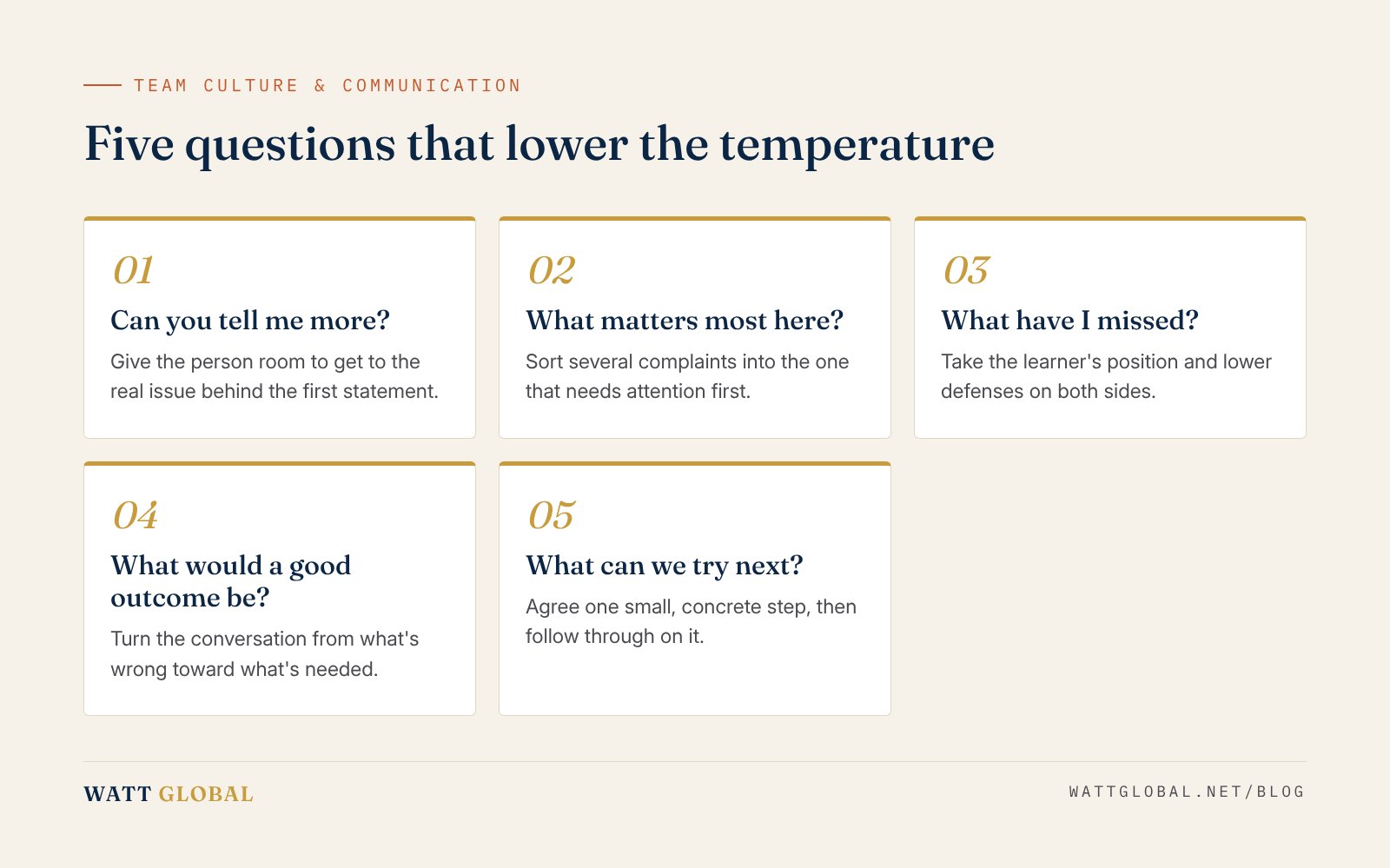
1. "Can you tell me more about that?"
This is the opening move, and it does most of the work. When someone is upset, their first statement is rarely the whole story. "This schedule is ridiculous" might really mean "I can't get my kid to school on Tuesdays." Asking for more, in a calm, genuinely interested tone, gives the person room to get to the real issue.
Watch your tone. The same words said with a sigh sound like "Here we go again." Said with interest, they sound like "I want to understand."
2. "What matters most to you here?"
Once the person has said more, help them find the center of it. Tense conversations often carry several complaints at once. This question sorts them. It also moves the conversation from what's wrong toward what the person needs, which is much easier to work with.
3. "What have I missed?"
This is the question that lowers defenses fastest, because it puts you in the position of the learner. You are not admitting fault. You are acknowledging that you may not have the whole picture, which is almost always true. For managers especially, asking this in front of a team shows that it is safe to fill in the gaps.
4. "What would a good outcome look like for you?"
Now you turn toward a resolution. Asking the other person to describe a good outcome often reveals that it's smaller and more reasonable than you feared. Sometimes the answer is "I just needed someone to know this was a problem." Sometimes it's a specific change you can make, or a clear reason why you can't.
5. "What's one thing we can try next?"
Close on a small, concrete step. Not a full solution, just the next move. "Let me check whether we can swap the Tuesday shift, and I'll come back to you by Thursday" is far more calming than a vague promise to look into it. Then keep your word. Following through is what makes the next difficult conversation easier.
Putting it to work: two quick scenarios
Picture a shift supervisor who announces a new break rotation. One of her most experienced team members says, in front of everyone, "Whoever came up with this has never worked a Saturday."
The push response: "This was approved by operations, and it's final." The retreat response: "Okay, let's talk about it later," then never doing so.
The question response: "Tell me more. What happens on Saturdays that this misses?" The team member explains that Saturday volume peaks right when two people would be on break at once. The supervisor asks what a good outcome would look like, they agree to stagger Saturday breaks by fifteen minutes, and she says she'll confirm it with operations by Friday. The whole exchange takes three minutes, and the team just watched a disagreement get handled well.
Now picture a project lead whose peer pushes back hard in a planning meeting. Instead of defending the timeline, the lead asks, "What have I missed?" The peer points out a dependency nobody had flagged. The timeline changes, and so does the relationship.
Habits that make the questions work
Questions alone won't help if everything around them signals impatience. A few habits make a real difference:
- Slow your pace. Speak a little slower and a little lower than you feel like speaking. People match the pace of the conversation.
- Pause after asking. Let the question land. Filling the silence takes the question back.
- Reflect before responding. A short summary, such as "So the Saturday timing is the real problem," shows you heard it.
- Separate the person from the point. You can disagree with the idea and still respect the person raising it.
- Know when to pause the conversation. If emotions are too high, it's fine to say, "I want to get this right. Can we pick it up at two o'clock?" Then show up at two.
Building the skill across a team
One person using these questions helps. A whole team using them changes the culture. When everyone shares the same simple language for tense moments, conversations recover faster and people stop avoiding the hard topics.
That's the idea behind Better Conversations in the Moment™, one of WATT Global's three 45-minute training modules. It gives teams practice with exactly these moves, in realistic scenarios, so they're available under pressure rather than only in theory. It follows the Training stage of the WATT Framework: practice the skill until it becomes a habit. The module pairs well with our wider team and culture workshops for teams that want to go further.
The takeaway
Difficult conversations at work rarely arrive on schedule. You can't prepare for every one, but you can prepare how you'll respond. Five questions, asked with real curiosity, are often enough to turn a tense moment into a useful one:
- Can you tell me more about that?
- What matters most to you here?
- What have I missed?
- What would a good outcome look like for you?
- What's one thing we can try next?
Try one this week, the next time a conversation starts to heat up, and notice what changes.
If you'd like your team to practice these skills together, get in touch about bringing Better Conversations in the Moment to your organization. We'll tailor the scenarios to the conversations your people actually have.