From Conflict to Connection: A Manager's Guide to Workplace Disagreement
Disagreement can make a team sharper or smaller. A practical, five-step guide for managers who want to keep conflict useful and relationships intact.
Every manager inherits conflict. Two team members who can't agree on a process. A long-running friction between shifts. A disagreement in a meeting that turns personal before anyone notices. Managing conflict at work is part of the job whether or not anyone trained you for it, and for most new managers, nobody did.
The instinct is to treat conflict as a problem to make go away. But disagreement is also how teams find better answers, catch risks and test assumptions. The goal isn't a team that never disagrees. It's a team that can disagree well and come out more connected than it went in. This guide gives you a practical way to get there.
Why conflict isn't the enemy
Teams that never disagree are usually not aligned. They're quiet. People have decided that raising a different view costs more than it's worth, so problems go underground and resurface later as resentment, workarounds or turnover.
Research on teams backs this up. Amy Edmondson's 1999 study of 51 manufacturing teams found that psychological safety, a shared belief that the team is safe for interpersonal risk-taking, predicted learning behavior, which in turn predicted performance. Open disagreement is one of those learning behaviors. When a team can push back on an idea without damaging the relationship, it gets smarter.
The trouble starts when disagreement about the work turns into friction between people. That shift is what managers need to watch for and prevent.
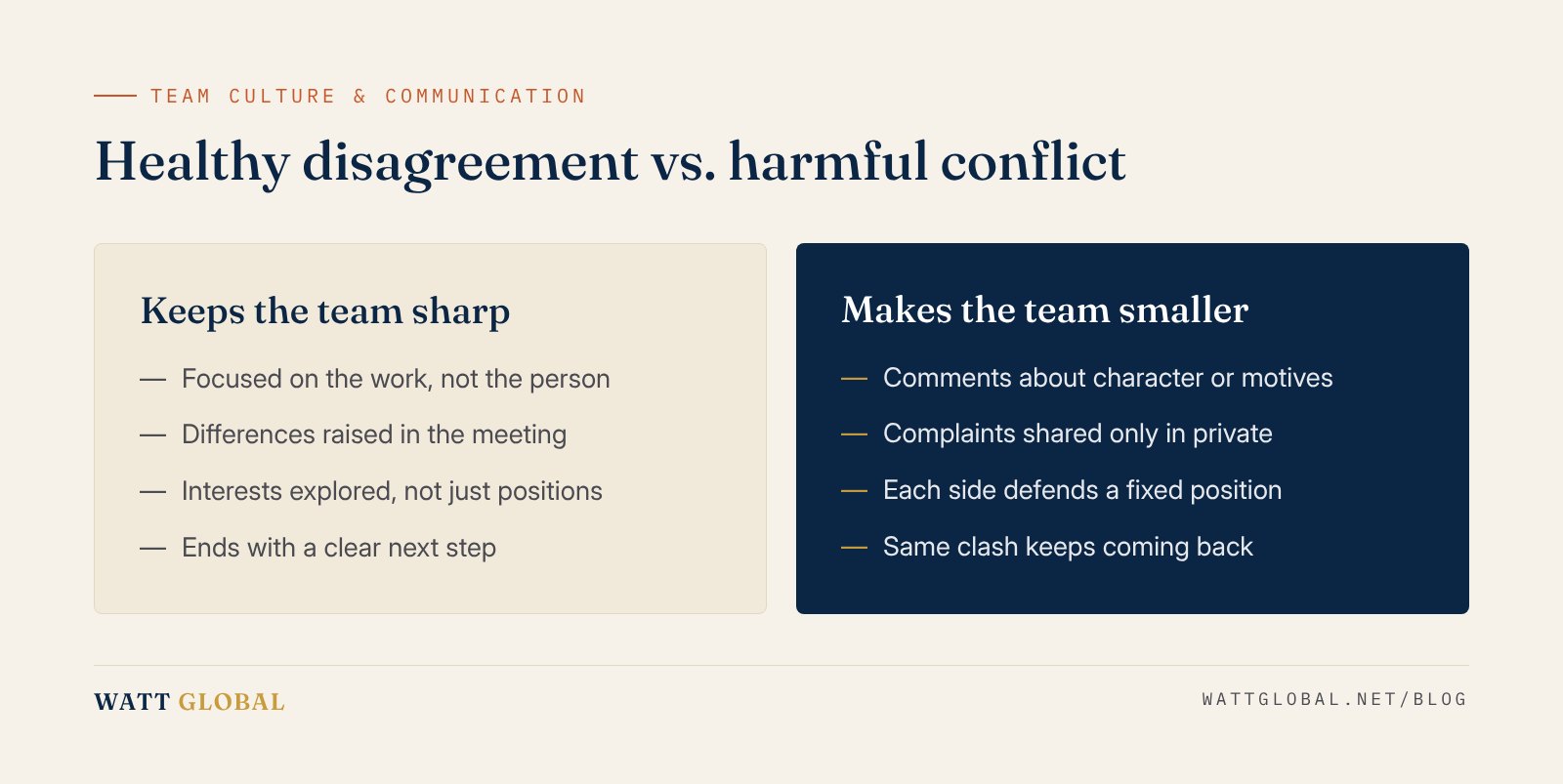
Disagreement about the work makes a team sharper. Disagreement about each other makes it smaller. Your job is to keep it on the work.
Know which kind of conflict you're dealing with
Before you step in, take a moment to diagnose. Most workplace conflict falls into a few broad types, and each needs a slightly different response.
- Task conflict: disagreement about what to do or how to do it. Usually healthy, if it stays respectful.
- Process conflict: disagreement about who does what, when, and by which rules. Often a sign that roles or handoffs are unclear.
- Relationship conflict: friction between people that has become personal. The most damaging, and often started by an unresolved task or process conflict.
- Values conflict: a deeper clash about what matters, such as speed versus thoroughness. Rarely "solved," but it can be managed with clear agreements.
Naming the type helps you avoid the classic mistake: treating a process problem as a personality problem. If two people keep clashing over handoffs, a better handoff may fix more than a talk about attitudes.
A five-step approach for managers
When conflict needs your involvement, a simple structure keeps you fair and keeps the conversation moving.

1. Step in early
Small frictions are easy to address. Long-running ones are not. If you notice repeated tension, a sharp tone in meetings or people routing around each other, act within days, not months. Early doesn't mean heavy-handed. A short check-in ("I noticed some tension in this morning's huddle. How are you seeing it?") is often enough.
2. Listen to each side separately first
Before bringing people together, talk to each one privately. Ask open questions: What happened? What matters most to you? What do you think the other person would say? This lets people be heard without performing for an audience, and it gives you a fuller picture before you facilitate.
3. Bring them together around a shared goal
When you meet jointly, open with something both people care about: the customer, the shift running smoothly, the project deadline. Then set simple ground rules: one person speaks at a time, describe behavior rather than character, and focus on what happens next rather than who was right.
4. Separate positions from interests
People arrive with positions: "We have to do it my way." Underneath are interests: "I'm worried about errors," "I need predictable hours." Ask questions that surface those interests. Two positions often look incompatible while the interests behind them can both be met.
5. Agree on a specific next step, and follow up
Close with a concrete agreement: who will do what, by when, and how you'll know it's working. Then put a follow-up on the calendar. A week later, check in with both people. Following up is the part most managers skip, and it's the part that turns a truce into trust.
What to avoid
Even well-meaning managers make a few predictable mistakes:
- Picking a side too early. The first account you hear will always sound convincing. Wait until you've heard both.
- Forcing a handshake. Insisting that people "just get along" without addressing the real issue pushes conflict underground.
- Solving it for them. If you impose a solution, they won't own it. Guide the conversation, but let them build the agreement.
- Ignoring patterns. If the same conflict keeps coming back with different people, the cause is likely a system, a role or a process, not the individuals.
- Treating everything as a performance issue. Some conflict needs HR involvement, especially anything involving harassment, discrimination or safety. Know where that line is in your organization and use the proper channel.
A quick scenario
Picture a maintenance lead and a dispatcher who have been clashing for weeks. The lead thinks dispatch sends jobs without enough detail. The dispatcher thinks maintenance is slow to respond. In meetings, they've stopped making eye contact.
Their manager talks to each privately and finds that both are frustrated by the same thing: the work order form doesn't have a field for the information maintenance needs. Neither person is the problem; the form is. In a joint conversation, they agree on three details dispatch will always include, and the manager asks IT to add a field. Two weeks later, the follow-up check-in is short. The tension has mostly gone, because the cause has.
That's what "conflict to connection" looks like in practice: the disagreement points to something real, and resolving it together builds a working relationship that's stronger than before.
Building the skill across your team
Managers shouldn't have to resolve every disagreement personally. The healthiest teams have a shared approach that everyone can use: listen first, separate the issue from the person, look for interests under positions, and agree on a next step.
That shared approach is the focus of Conflict to Connection™, one of WATT Global's three 45-minute modules. Teams practice real disagreements in a structured, low-stakes setting so the skills are there when the real thing happens. It builds on the Awareness stage of the WATT Framework: recognizing patterns, listening and understanding your impact on others. Many organizations combine it with Better Conversations in the Moment™ as part of a broader team workshop series.
Moving forward
Managing conflict at work isn't about keeping the peace at any cost. It's about keeping disagreement useful. Step in early, listen to each side, anchor on a shared goal, look beneath positions, and follow up. Do that consistently and your team will start resolving more of its own conflicts, and trusting each other more in the process.
If disagreement is slowing your team down, tell us what you're seeing. We'll help you find the right starting point, whether that's one manager or a whole department.