Find Your Spark: Why Personal Transformation Comes Before Organizational Change
Teams follow the person, not the strategy deck. Why personal transformation in leadership comes first, and four practical stages to begin this week.

Organizations spend a lot of energy on change: new strategies, new structures, new systems, new values printed on the breakroom wall. Far less attention goes to a simpler question. Have the people leading the change actually changed themselves?
It's an uncomfortable question, and it's the right place to start. Teams don't follow the strategy deck. They follow the person in front of them. If that person is running on autopilot — reacting, rushing, avoiding the hard conversation — no amount of organizational design will make the change feel real. This post explains why personal transformation comes before organizational change, and how leaders can begin that work in a practical, unglamorous way.
Why leaders can't skip their own transformation
Every leader teaches, whether they mean to or not. People watch what you do under pressure far more closely than they listen to what you say in a town hall. If you announce a culture of open feedback but bristle when someone disagrees with you, the team learns the real rule in about a week.
That's why personal transformation in leadership isn't a "soft" add-on to organizational change. It's the foundation. The habits a leader practices daily become the norms a team treats as normal.
The numbers suggest many leaders are running low. Gallup's State of the Global Workplace research found that manager engagement fell from 30% to 27% in 2024. A disengaged leader can still deliver a plan, but it's very hard for them to inspire anyone else to change.
You can't hand someone a spark you haven't found yourself. Start with your own, and the people around you will notice before you say a word.
What "finding your spark" actually means
"Find your spark" can sound like a motivational poster. In practice, it's far more concrete. It means reconnecting with three things that tend to get buried under deadlines and routine:
- Purpose: why the work matters to you, beyond the job description.
- Energy: what restores you and what drains you, and whether your days are built around the right one.
- Ownership: the choices that are genuinely yours, even when circumstances aren't.
Shawn Watt's book, WATT: Find Your Spark!, starts from a hard truth drawn from his own life: the circumstances of your beginning do not determine the significance of your future. That belief is the core of personal transformation. Where you start is not where you have to stay — but moving requires deliberate effort, not waiting for inspiration.
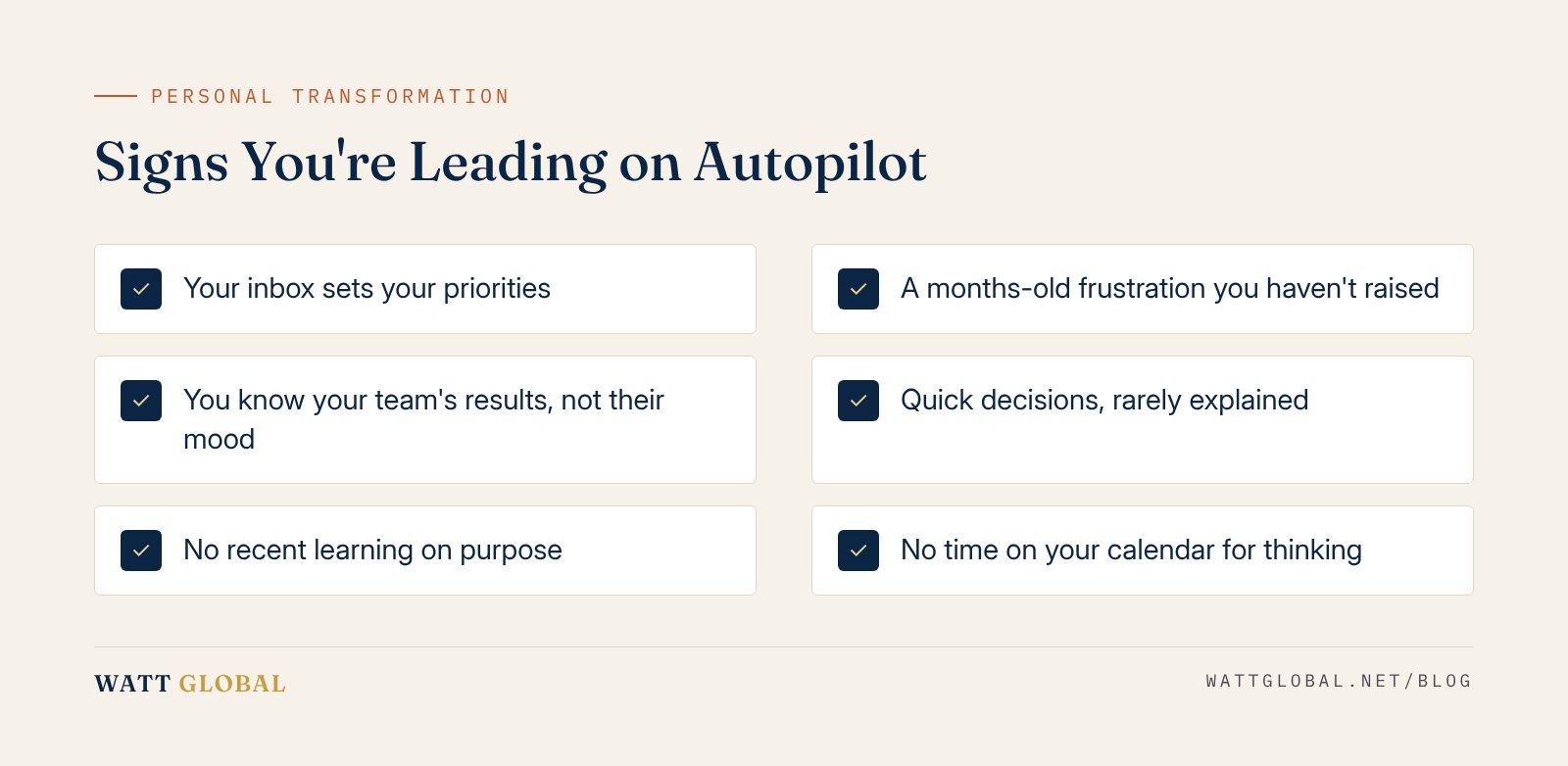
Signs you're leading on autopilot
Before you can change, you have to notice. Here are common signs that a leader has drifted into autopilot:
- You spend most days reacting to your inbox instead of the priorities you set.
- You've had the same frustration with the same person for months but haven't raised it.
- You can describe your team's results in detail but not how they're feeling.
- You make decisions quickly but rarely explain the reasoning.
- You can't remember the last time you learned something new on purpose.
- Your calendar has no time for thinking, only for meetings.
None of these make someone a bad leader. They make someone a busy one. The danger is that busy becomes the identity, and the spark quietly goes out.
The four stages of personal transformation
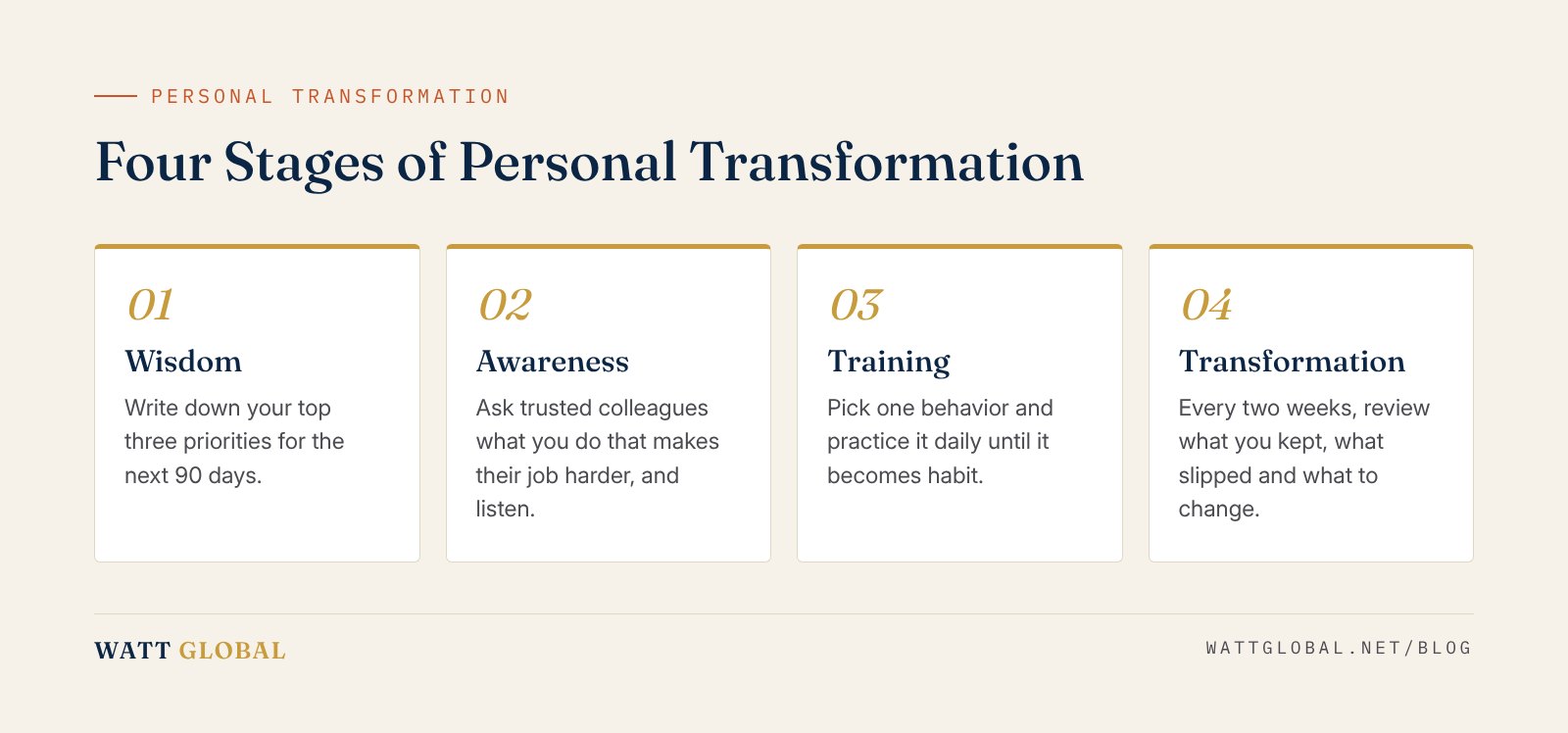
The WATT Framework™ — Wisdom, Awareness, Training and Transformation — was found in personal change long before it was applied to organizations. The same four stages work for an individual leader.
Wisdom: get clear on what matters
Start by clarifying your purpose and priorities. What do you want your leadership to stand for? Which decisions truly need you, and which are you holding on to out of habit? Write down your top three priorities for the next 90 days. If everything is a priority, nothing is.
Awareness: see your own patterns
Next, look honestly at how you actually operate. Ask two or three trusted colleagues a simple question: "What's one thing I do that makes your job harder?" Then listen without defending yourself. Notice the patterns that show up under stress. Awareness is uncomfortable, and it's where real change begins.
Training: build the habit, not just the insight
Insight fades fast without practice. Pick one behavior to change and practice it daily. That might be ending every one-on-one by asking "What do you need from me?" or blocking 30 minutes each morning for planning before opening email. Small, repeated actions beat big resolutions every time.
Transformation: review, adjust, keep going
Finally, review your progress against the goals you set. Every two weeks, ask yourself: Did I do what I said I'd do? What got in the way? What will I change next? Transformation isn't a moment of breakthrough. It's the steady accumulation of small, kept promises to yourself.
From personal change to organizational change
Here's where it comes back to the organization. Picture a department head preparing to roll out a new way of running team meetings: shorter, more focused and with real space for disagreement. Before the announcement, she spends a month practicing it herself in her own staff meetings. She asks for feedback, adjusts, and admits openly when she slips back into old habits.
By the time she asks her managers to change, they've already seen her do it. The change isn't a directive anymore. It's an invitation to join something already happening.
That's the pattern behind lasting organizational change: leaders go first. Not perfectly, but visibly. When people see a leader working on themselves, they get permission to do the same.
What gets in the way
If personal transformation were easy, every leader would already be doing it. A few obstacles show up again and again:
- Waiting to feel ready. Motivation usually follows action, not the other way around. Start small and let the momentum build.
- Trying to change everything at once. One habit, practiced consistently, beats five abandoned resolutions.
- Doing it alone. A trusted peer, mentor or coach who asks "Did you do what you said?" makes follow-through far more likely.
- Treating a bad week as failure. Every leader slips. The difference is whether you notice and return to the habit, or quietly let it go.
Start with yourself this week
Personal transformation doesn't require a retreat or a sabbatical. It requires honesty, a little structure and the discipline to keep going on the days you don't feel like it. Clarify what matters, notice your patterns, practice one new habit and review it regularly. Do that, and you'll be a different leader in 90 days — and your team will be different too.
If you'd like a starting point, the free WATT Assessment takes about four minutes and shows where you stand across all four stages. And if you're ready to go deeper, the full story and the practices behind the framework are in Shawn's book — read WATT: Find Your Spark! and begin your own transformation from the inside out.