Discipline Beats Motivation: Leadership Habits That Survive a Bad Week
Motivation fades when the week goes wrong. Here is how to design leadership habits small and sturdy enough to hold under pressure.

Motivation is wonderful when it shows up. It makes Monday plans feel easy and big goals feel close. Then comes the week when a key person resigns, a project slips, a family member gets sick and you sleep five hours a night. Motivation leaves. Whatever you do as a leader that week is not driven by inspiration. It is driven by habit.
That is why the leadership habits worth building are not the ones that look impressive on a good day. They are the ones small and sturdy enough to survive a bad week. This post covers why discipline outlasts motivation, how to design habits that hold under pressure and five leadership habits worth protecting when everything else is slipping.
Why motivation is an unreliable leadership strategy
Motivation is a feeling, and feelings fluctuate. They rise with good news and sleep, and drop with stress, conflict and fatigue. Leaders who rely on motivation tend to lead brilliantly in calm weeks and inconsistently in hard ones, which is exactly when their teams need them most.
Leaders are not immune to strain. Gallup's State of the Global Workplace found that manager engagement fell from 30% to 27% in 2024. If you have felt your own energy for leading dip, you are in large company. The answer is not to wait for motivation to return. It is to build a floor beneath your leadership that holds when energy runs low.
Motivation decides what you want. Discipline decides what you do when you don't feel like it. Your team only ever sees the second one.
What discipline actually means for leaders
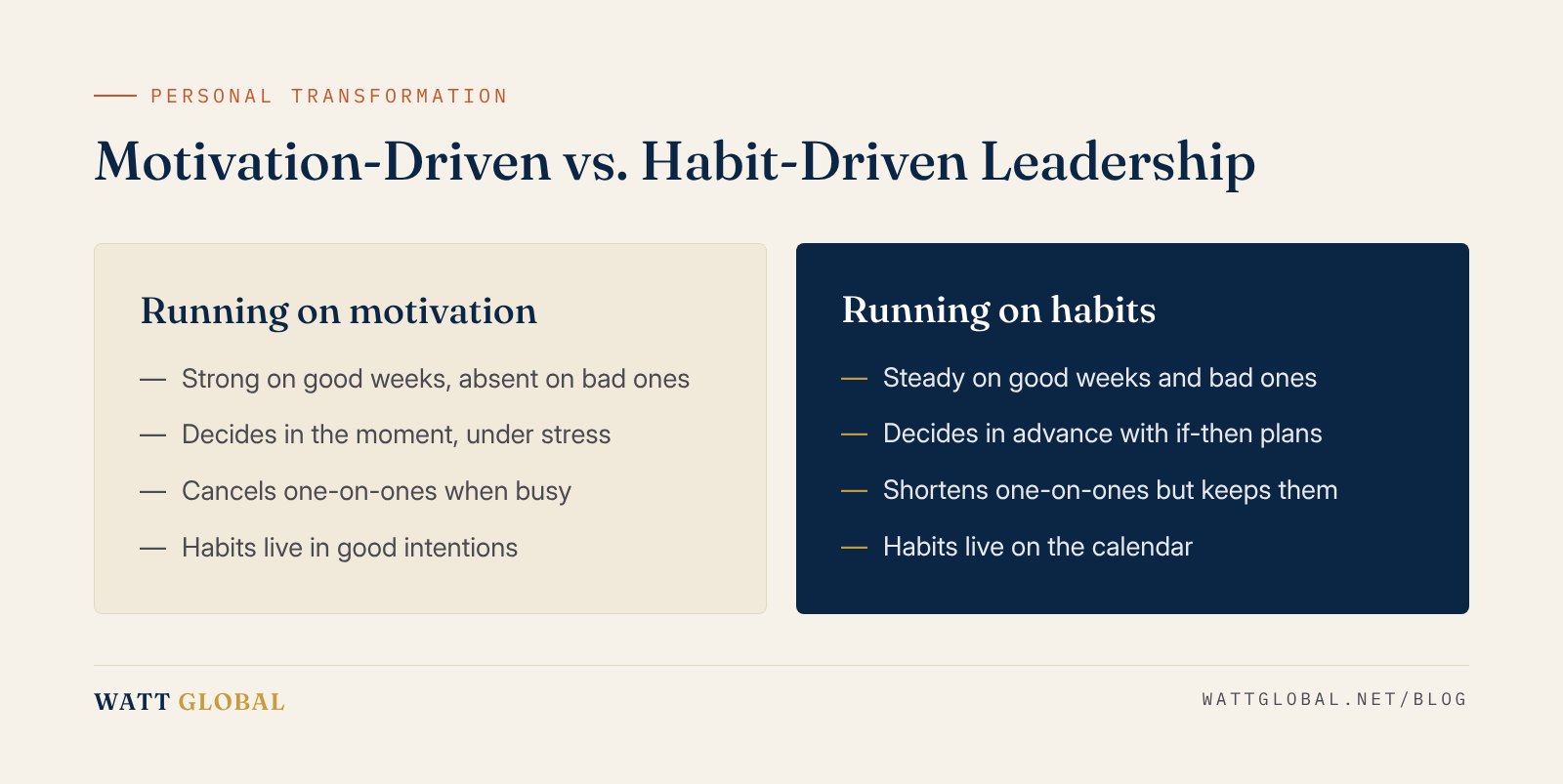
Discipline has a bad reputation. It sounds like rigid schedules, cold showers and willpower. For leaders, a more useful definition is simpler: deciding in advance what you will do, so you don't have to decide in the moment.
Disciplined leaders are not people with endless willpower. They are people who have reduced how often they need it. They have turned their most important behaviors into defaults, built into their calendar, their routines and their environment.
Designing habits that survive a bad week
Most leadership habits fail because they are designed for an ideal week. A few design principles make them sturdier.
Make the minimum version tiny
Every habit needs a "bad week" version that is almost too small to skip. If your habit is a 30-minute weekly one-on-one with each direct report, the minimum version might be a 10-minute check-in. If your habit is a weekly planning hour, the minimum might be writing down three priorities on Monday morning. Doing the small version keeps the habit alive until normal weeks return.
Attach it to something that already happens
Habits stick better when they are tied to an existing anchor: the first coffee, the drive home, the Monday team meeting, the end of a shift. "After the shift handoff, I'll spend two minutes noting one thing that went well" is easier to keep than "I'll reflect more."
Put it on the calendar, not in your intentions
If it matters, it gets a time. Protect that time as you would a meeting with your own manager. When you have to move it, move it, but do not delete it.
Decide your "if-then" plans in advance
Anticipate the obstacles. "If my one-on-one gets bumped by an emergency, then I'll reschedule it before the end of the same day." "If I miss my Friday review, then I'll do the five-minute version on Saturday morning." Deciding in calm moments saves willpower for stressful ones.
Track it lightly
A simple tick on a calendar or a note in your phone is enough. The point is not perfect data. It is making your consistency visible to yourself, so a slipping habit gets noticed in week one, not month three.
Five leadership habits to protect when everything else slips
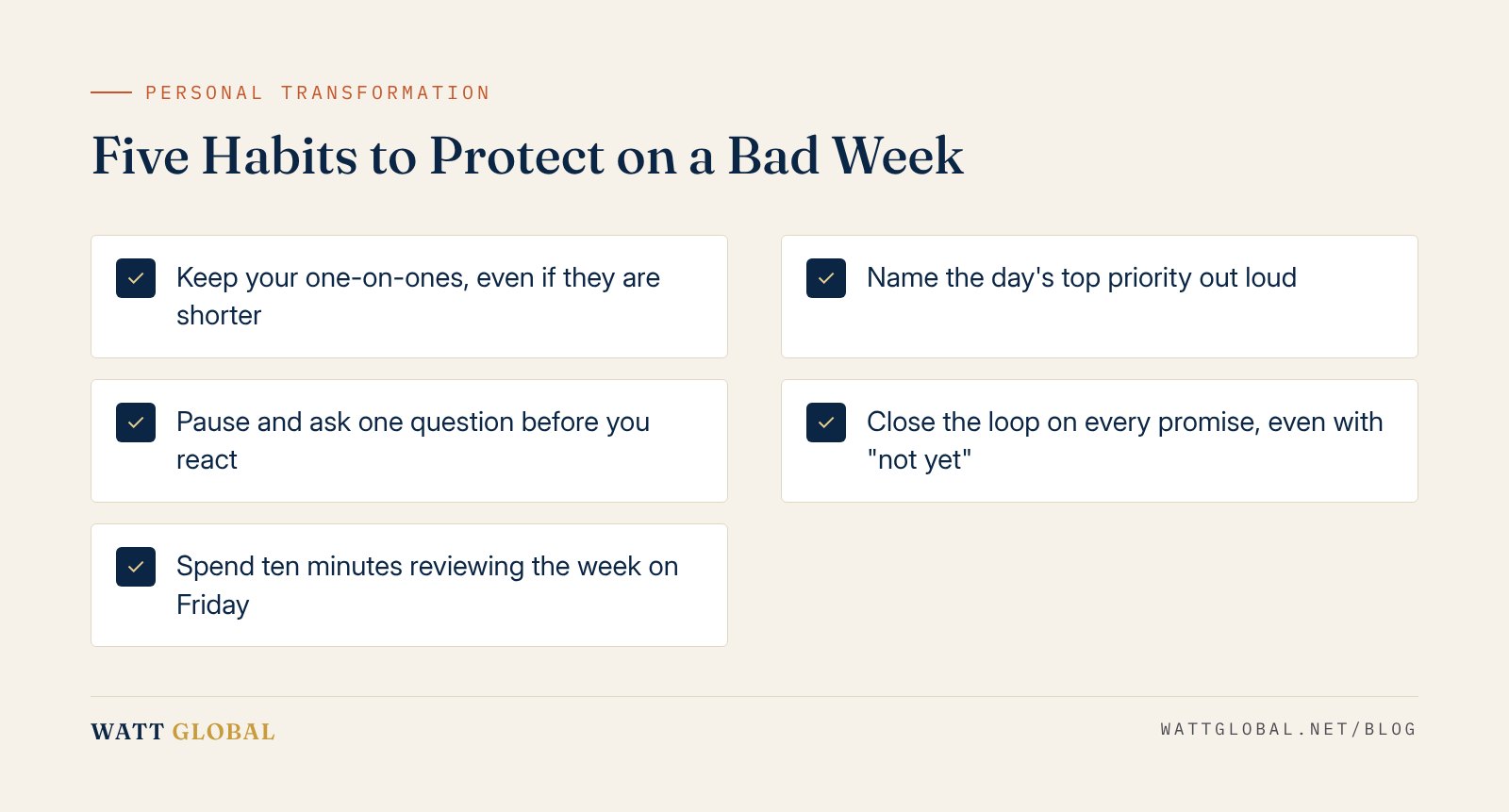
Not every habit is equally important. When the week goes wrong, protect these first:
- Keep your one-on-ones, even if they are shorter. Canceling them sends a message about what matters. A short version keeps the connection.
- Name the priority out loud. In a chaotic week, your team needs to hear what matters most, and what can wait. One sentence at the start of the day is enough.
- Respond before you react. Build in a short pause, even a breath or a single question, before you answer bad news or a frustrated colleague. Stress shortens fuses; habits lengthen them.
- Close the loop. If you said you would get back to someone, do it, even if the answer is "I don't know yet." Reliability is built in the small promises.
- Review the week for ten minutes. On Friday, ask: What went well? What did I avoid? What will I do differently next week? This is the habit that keeps all the others honest.
Picture a nurse manager in the middle of a staffing crunch. She cannot run her usual 30-minute check-ins, so she switches to ten-minute ones, standing at the station, and keeps every single one. She names one priority at each shift huddle. When the crunch ends, her team describes that month as hard but steady, and they credit her for the steadiness.
How the WATT Framework builds discipline
At WATT Global, we see habits as the bridge between knowing and becoming. The WATT Framework moves through four stages, and habits run through all of them:
- Wisdom: clarify the few priorities and decisions that matter, so your habits serve something real.
- Awareness: notice your patterns under pressure: what you skip, what you overdo and what triggers it.
- Training: practice the behavior until it becomes a default, not an effort.
- Transformation: review progress against the goals you set, and apply what you learn to the next cycle.
This idea sits at the heart of Shawn Watt's book, WATT: Find Your Spark!: lasting change comes less from a single burst of inspiration than from steady, deliberate practice. Our executive and leadership coaching works the same way, focusing on the specific habits a leader needs to hold under real pressure.
Build for your worst week, not your best
Your best weeks will take care of themselves. Your leadership is defined by what you keep doing when the week is going badly. Choose one habit from this list, design its tiny version, attach it to an anchor and protect it for the next month. That is how discipline is built: not all at once, but one small promise kept at a time.
If you want to know which of your leadership habits are strongest and which are most likely to slip under pressure, take the free 4-minute WATT Assessment. It shows where you stand across all four stages of the framework, so you know where to focus first.