The First 90 Days as a New Manager: A Week-by-Week Plan
A practical week-by-week plan for your first 90 days as a manager: listen first, set direction, then build the habits that last.

The first time you manage people, the job changes overnight but your calendar does not tell you how. Yesterday you were measured on your own output. Today you are measured on what a group of people produces, and most of what you do to help them is invisible: a question asked at the right moment, a priority made clear, a problem caught early.
That shift is hard, and most new managers make it with very little support. This plan breaks your first 90 days into weeks so you know what to focus on, what to leave alone and what "good" looks like at each checkpoint. Treat it as a scaffold, not a script. Your team, your organization and your starting conditions will bend it, and that is fine.
Why the first 90 days deserve a plan
New managers rarely fail because they lack skill in the work. They struggle because nobody taught them the new work: setting direction, giving feedback, holding standards and protecting their team's focus.
The evidence suggests this gap is common. In LifeLabs Learning's 2026 mid-year research covering more than 20,000 people, 56% rated their manager's coaching and feedback capability at 5 out of 10 or lower, and only 14% rated it 8 to 10. Managers themselves are feeling the strain too: Gallup's State of the Global Workplace found manager engagement fell from 30% to 27% in 2024.
A plan will not fix an organization's development budget. It will give you a way to spend your first three months on the things that compound, instead of reacting to whatever lands in your inbox.
The first 90 days are not about proving you deserved the promotion. They are about learning what your team needs from you that it is not getting yet.
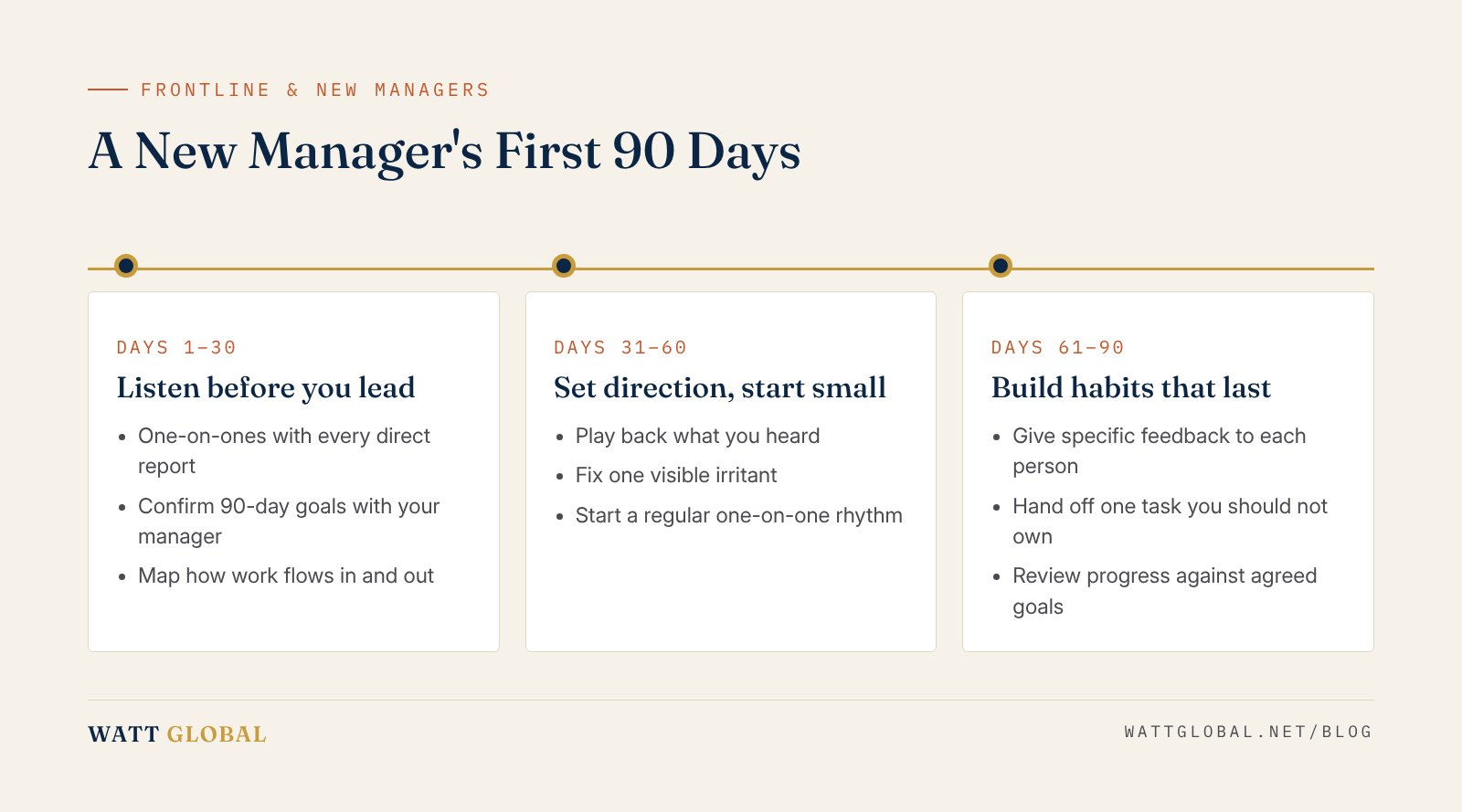
Days 1–30: Listen before you lead
Your first month is for learning. Resist the urge to fix things, even obvious things. You do not yet know why the current way exists, who depends on it or what it would cost to change.
Week 1: Meet everyone, one at a time
Schedule a 30- to 45-minute one-on-one with every direct report. Keep the agenda simple and ask the same questions of each person so you can compare answers:
- What is going well on this team that I should protect?
- What gets in the way of your best work?
- What do you wish your last manager had done more of, or less of?
- How do you like to receive feedback?
- What would you like to be doing a year from now?
Take notes. Say very little. Your job this week is to be curious and visibly interested.

Week 2: Meet your own manager properly
Ask your manager three things: what success looks like at 90 days, which two or three results matter most this quarter, and how they want to hear from you (weekly email, a standing meeting, only when something breaks). Write the answers down and confirm them in a short follow-up note.
Weeks 3–4: Map the work and the people around it
Learn how work flows in and out of your team. Who sends you requests? Who relies on your output? Meet your peers in adjacent teams. By the end of month one, you should be able to describe, in plain language, what your team is for and where it gets stuck.
Days 31–60: Set direction and start small
In the second month you move from listening to shaping. You have enough context to make a few decisions, and your team is watching to see what you do with what they told you.
Week 5: Play back what you heard
Hold a team meeting and summarize the themes from your one-on-ones, without naming who said what. Then name two or three priorities for the next 60 days. Showing people that you listened builds more trust than any speech about your leadership style.
Weeks 6–7: Pick one visible quick win
Choose one irritant that several people raised and that you can actually fix: a meeting that wastes time, a handoff that keeps failing, an approval nobody understands. Fix it, and say out loud that you fixed it because they told you about it.
Week 8: Start real one-on-ones
Move from get-to-know-you conversations to a regular rhythm, weekly or every other week. Let your direct report own the first half of the agenda. Use the second half for priorities, feedback and development. This is the single habit that does the most to separate effective new managers from struggling ones.
Days 61–90: Build habits that will outlast the plan
The third month is where you turn early wins into a way of operating. Anything you do only once does not count as a habit yet.
Weeks 9–10: Give your first round of specific feedback
By now you have seen each person's work for two months. Give each direct report at least one piece of specific positive feedback and, where it is warranted, one piece of constructive feedback. Describe the behavior, the impact and what you would like to see next. Keep it short and private.
Week 11: Check your own patterns
Ask yourself honestly where you have defaulted to your old role. Are you still doing the work you used to do because it feels productive? Are you the bottleneck on decisions your team could make? Pick one thing to hand off.
Week 12: Review against what you agreed
Go back to the 90-day expectations you confirmed with your manager in week two. Review progress together. Then share a short version with your team: what changed, what you learned and what comes next.
Mistakes that derail new managers
Most first-90-day problems fall into a handful of patterns. Watch for these:
- Changing too much, too fast. Early changes signal that you did not listen, even when they are good ideas.
- Staying the best individual contributor on the team. Your output now counts less than everyone else's.
- Avoiding the first hard conversation. Small issues left alone in month one become performance issues by month six.
- Skipping one-on-ones when things get busy. Busy weeks are exactly when your team needs them most.
- Managing everyone the same way. Your week-one answers told you how each person wants to be led. Use them.
Using a framework to stay steady
A week-by-week plan tells you what to do. A framework helps you understand why it works, so you can adapt when the plan stops fitting. At WATT Global we use the WATT Framework, which moves through four stages that line up neatly with a new manager's first months:
- Wisdom: clarify purpose and the few decisions that matter most (your conversations with your manager).
- Awareness: recognize patterns, listen and understand your impact (your first 30 days).
- Training: practice the skills and build the habits (one-on-ones and feedback).
- Transformation: review progress against agreed goals and apply what you learned (your 90-day review).
Picture a newly promoted shift supervisor who spends month one quietly learning why the handoff between shifts keeps breaking, fixes it in month two with the people who raised it, and by month three runs a five-minute handoff huddle that nobody has to remind them about. That is the whole arc in miniature: see clearly, listen, practice, then make it stick.
Organizations that want to support new managers more directly can pair a plan like this with coaching or leadership workshops so new managers are not figuring it out alone.
Start with an honest baseline
The most useful thing you can bring into your first 90 days is an accurate picture of where you are starting from: what you already do well as a leader and where your habits are likely to slip under pressure. Knowing that early lets you choose which weeks of this plan need the most attention.
If you want that baseline before you begin, take the free 4-minute WATT Assessment. It walks you through sixteen questions across Wisdom, Awareness, Training and Transformation and shows you which stage to strengthen first.