How to Give Feedback That Actually Changes Behavior
Most feedback is forgotten within a week. A four-part structure, better timing and real follow-up turn feedback into lasting change.

Most managers give feedback. Far fewer give feedback that changes anything. The conversation happens, both people nod, and two weeks later the same behavior shows up again. The manager concludes the employee "isn't listening." The employee concludes the manager "doesn't get it." Nobody is quite wrong, and nothing improves.
The problem is rarely effort or good intentions. It is usually how the feedback is built. This guide covers how to give effective feedback that people can actually act on: what to say, when to say it, how to follow up and the common mistakes that make good feedback disappear.
Why most feedback doesn't stick
Feedback is one of the most-taught management skills and one of the least mastered. In LifeLabs Learning's 2026 mid-year research with more than 20,000 people, 56% rated their manager's coaching and feedback capability 5 out of 10 or lower. Only 14% rated it 8 to 10.
Feedback tends to fail for a few predictable reasons:
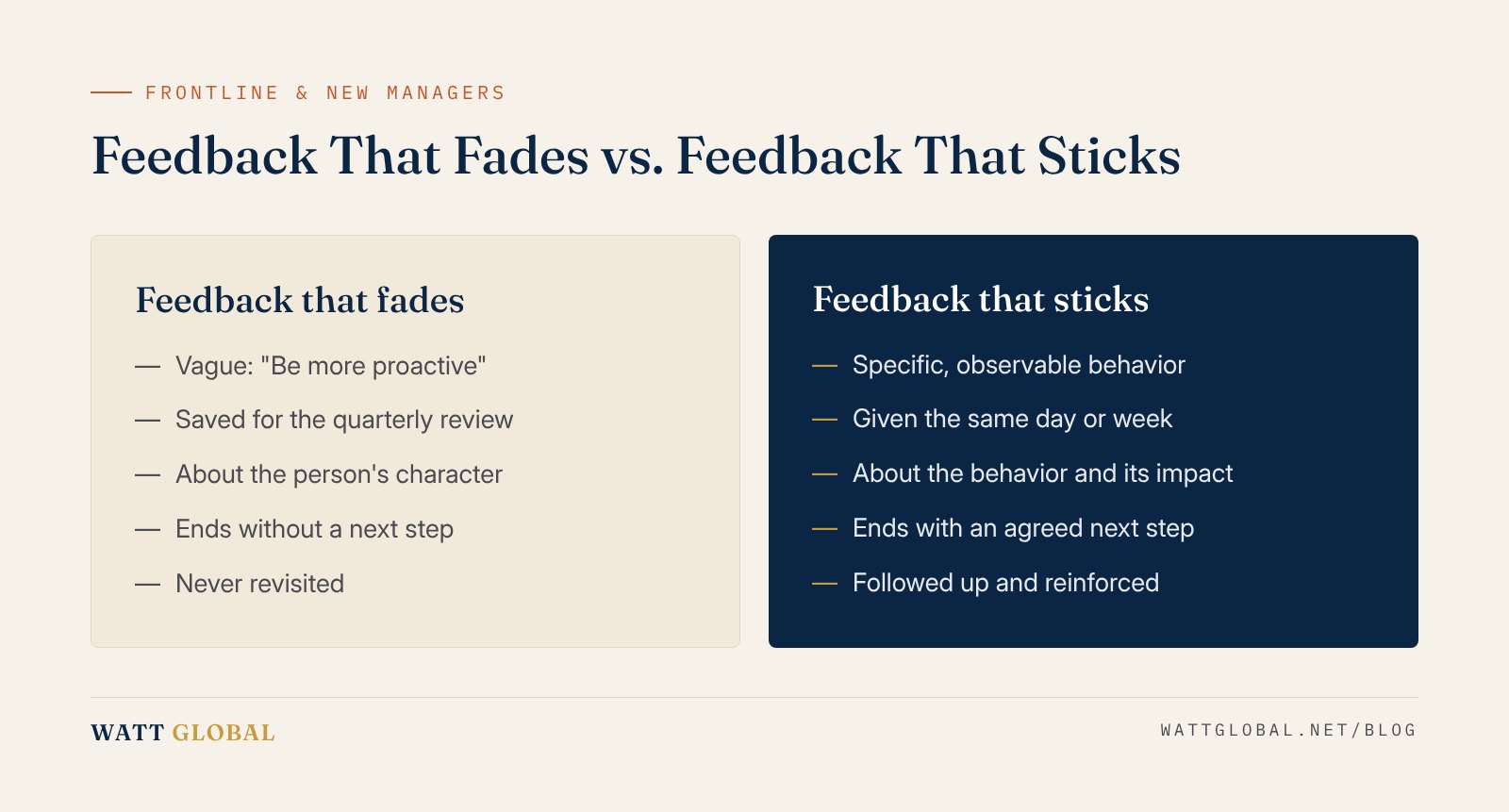
- It is too vague. "Be more proactive" or "great job" gives the listener nothing to repeat or change.
- It is too late. Feedback saved for a quarterly review arrives after the details have faded for both people.
- It is about the person, not the behavior. "You're careless" invites defense. "The report went out with last month's figures" invites a fix.
- It has no next step. If the conversation ends without a clear "what next," the default is "nothing."
- There is no follow-up. Behavior change takes repetition. One conversation rarely does it alone.
Feedback is not something you deliver. It is something the other person has to be able to use. If they can't act on it tomorrow, it wasn't finished.
A simple structure that works
You do not need an elaborate model. You need a structure short enough to remember under pressure. One that works in most situations has four parts.
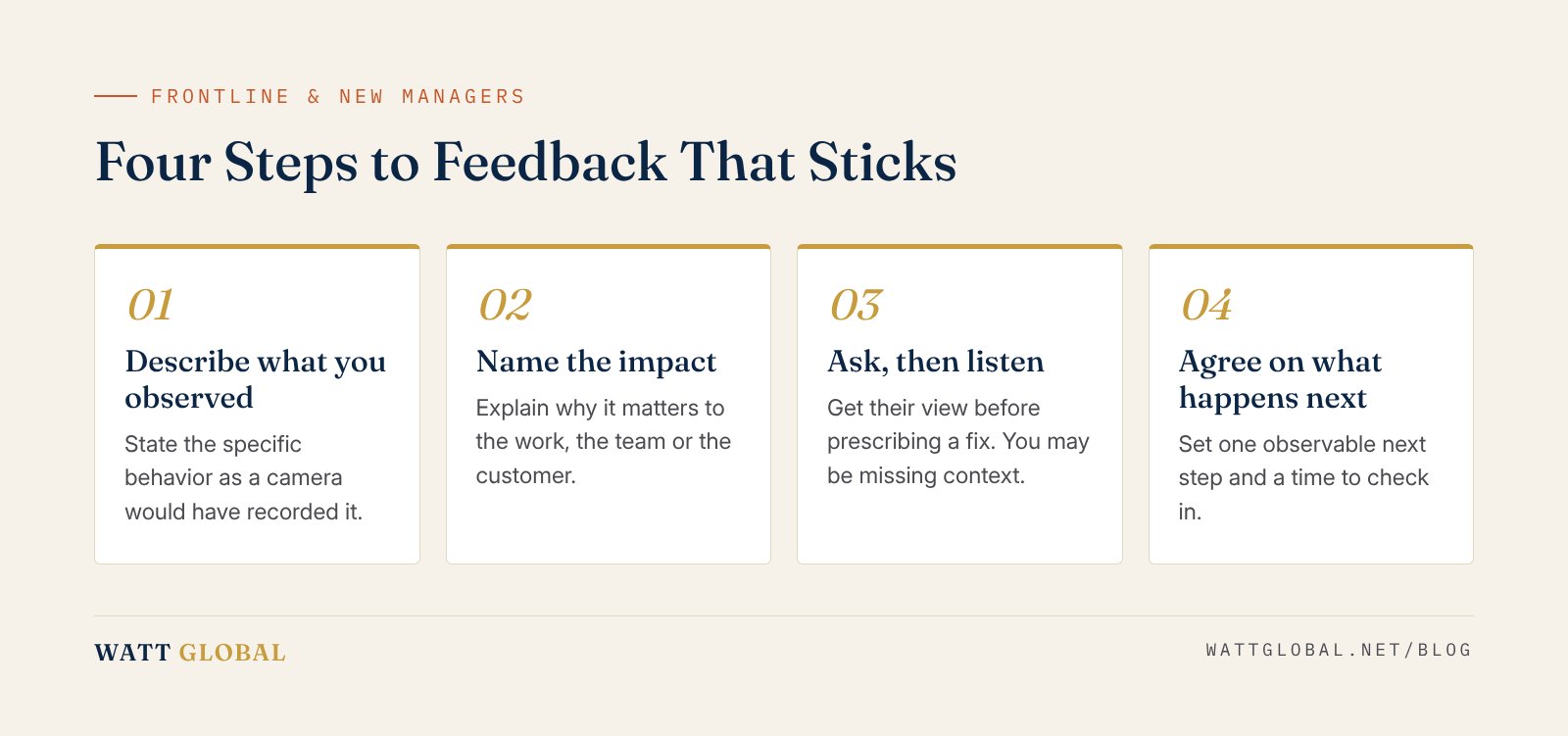
1. Describe what you observed
State the specific behavior, as a camera would have recorded it. Not your interpretation of it.
"In this morning's client call, you interrupted Dana twice while she was explaining the timeline."
2. Name the impact
Explain why it matters: to the work, the team, the customer or the person themselves.
"The client started directing questions only to you, and Dana didn't get to finish the part she'd prepared."
3. Ask, then listen
Before you prescribe a fix, ask for their view. There may be context you are missing, and people commit more to solutions they helped shape.
"How did that call feel from your side?"
4. Agree on what happens next
End with a specific, observable next step, and a time to check in.
"For Thursday's call, could you let Dana finish her section before you jump in? Let's compare notes right after."
That is it. Observation, impact, question, agreement. It takes two or three minutes when it is done well.
Timing, setting and frequency
How and when you give feedback matters almost as much as what you say.
Give it soon. The closer to the moment, the more useful it is. Same day is ideal; within a week is acceptable. Waiting months turns a small correction into a big surprise.
Give it privately when it is constructive. Positive feedback can be public if the person is comfortable with it. Constructive feedback almost always belongs in a one-on-one setting.
Give it often. If feedback is rare, every conversation feels high-stakes. If it is a normal part of how your team works, it feels like information rather than judgment.
Balance it honestly. Positive feedback is not a sweetener to make criticism go down easier. It is equally important information about what to keep doing. Be just as specific when something goes well: "The way you summarized the three options before asking for a decision made that meeting ten minutes shorter."
Adjusting for the person in front of you
The same words land differently with different people. A few adjustments help:
- Ask how they like to receive feedback. Some people want it immediately and bluntly. Others need a moment to process. Asking early, ideally before you ever need to give hard feedback, saves friction later.
- Watch for defensiveness, and slow down. If someone pushes back, go back to step three: ask and listen. Defensiveness often means they heard a judgment about who they are rather than what they did.
- Check for understanding. Ask them to put the next step in their own words. If they cannot, the feedback is not finished.
- Respect the power gap. Your words carry more weight than you think. A casual "that wasn't great" from a manager can echo for days.
Picture a warehouse team lead who notices a new hire skipping a safety check on the forklift. Instead of a sharp correction in front of the crew, he waits until the next break, describes exactly what he saw, explains the near-miss it could cause and asks what got in the way. The answer: nobody showed the new hire where the checklist is kept. One feedback conversation fixes a training gap, not just a behavior.
Following up: where behavior actually changes
Most feedback conversations end with good intentions. Behavior changes in the follow-up.
- Write down what you agreed. A one-line note after the conversation keeps both of you honest.
- Look for the next opportunity. Watch for the situation you discussed, and notice what happens.
- Reinforce progress quickly. When you see the new behavior, say so, specifically. This is the step managers skip most often.
- Revisit if nothing changes. Go back to the four-part structure, and be more explicit about the expectation and the consequence.
This rhythm of seeing clearly, practicing and reviewing progress is at the heart of the WATT Framework. Feedback is a Training-stage skill, but it only becomes a habit when it is reviewed and reinforced in the Transformation stage.
Building a feedback culture, not just feedback skills
One skilled manager helps. A team where everyone can give and receive feedback is much more resilient. That requires shared language and practice.
WATT Global's 45-minute module Speak Up, Listen In™ is designed for exactly this: helping teams practice raising concerns and listening without defensiveness, in a session short enough to fit into a working week. It pairs well with our broader team and culture workshops for organizations that want feedback to become part of how people work every day.
Make your next conversation count
Effective feedback is not about finding perfect words. It is about being specific, timely, curious and consistent, and about following up until the new behavior holds. Pick one person on your team this week, use the four-part structure once and notice what changes.
If you want to build these skills across a team or a whole management layer, reach out to WATT Global to discuss a feedback workshop. We will tailor it to the conversations your managers actually need to have.